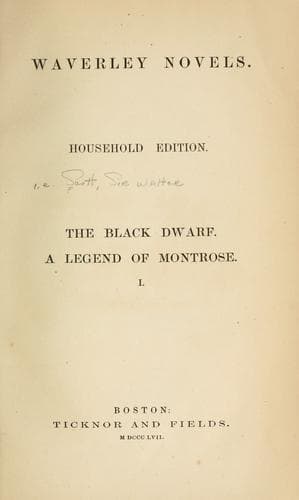
Historical fiction; Montrose, James Graham, Marquis of, 1612-1650 -- Fiction; Scotland -- History -- Charles I, 1625-1649 -- Fiction
Montrose allowed the force of these arguments, and owned, although the
matter was attended with difficulty, yet it seemed consistent with the
King’s service that it should be concluded as speedily as possible.
“I could wish,” said he, “that it were all settled in one way or
another, and that this fair Briseis were removed from our camp before
the return of our Highland Achilles, Allan M’Aulay.--I fear some fatal
feud in that quarter, Menteith--and I believe it would be best that Sir
Duncan be dismissed on his parole, and that you accompany him and his
daughter as his escort. The journey can be made chiefly by water, so
will not greatly incommode his wound--and your own, my friend, will be
an honourable excuse for the absence of some time from my camp.”
“Never!” said Menteith. “Were I to forfeit the very hope that has so
lately dawned upon me, never will I leave your Excellency’s camp while
the royal standard is displayed. I should deserve that this trifling
scratch should gangrene and consume my sword-arm, were I capable
of holding it as an excuse for absence at this crisis of the King’s
affairs.”
“On this, then, you are determined?” said Montrose.
“As fixed as Ben-Nevis,” said the young nobleman.
“You must, then,” said Montrose, “lose no time in seeking an explanation
with the Knight of Ardenvohr. If this prove favourable, I will talk
myself with the elder M’Aulay, and we will devise means to employ his
brother at a distance from the army until he shall be reconciled to his
present disappointment. Would to God some vision would descend upon his
imagination fair enough to obliterate all traces of Annot Lyle! That
perhaps you think impossible, Menteith?--Well, each to his service; you
to that of Cupid, and I to that of Mars.”
They parted, and in pursuance of the scheme arranged, Menteith, early on
the ensuing morning, sought a private interview with the wounded Knight
of Ardenvohr, and communicated to him his suit for the hand of his
daughter. Of their mutual attachment Sir Duncan was aware, but he was
not prepared for so early a declaration on the part of Menteith. He
said, at first, that he had already, perhaps, indulged too much in
feelings of personal happiness, at a time when his clan had sustained
so great a loss and humiliation, and that he was unwilling, therefore,
farther to consider the advancement of his own house at a period so
calamitous. On the more urgent suit of the noble lover, he requested a
few hours to deliberate and consult with his daughter, upon a question
so highly important.
Public-domain text, read in full here on John Shaqi.
Reviews
Reviews
No reviews yet
Be the first to share your thoughts on this work.
Elsewhere in the archive
Join the Discussion
Join the discussion
Sign in to leave a comment or review.
Sign InorCreate an account