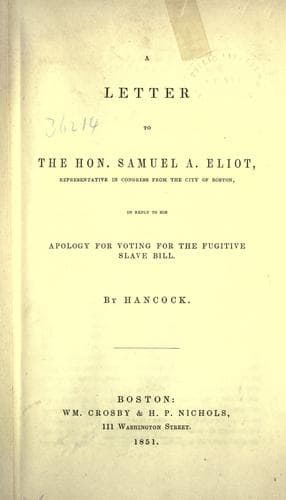
A Letter to the Hon. Samuel A. Eliot, Representative in Congress From the City of Boston, In Reply to His Apology For Voting For the Fugitive Slave Bill. — John Shaqi
A Letter to the Hon. Samuel A. Eliot, Representative in Congress From the City of Boston, In Reply to His Apology For Voting For the Fugitive Slave Bill.Dexter, Franklin
Philosophy
A Letter to the Hon. Samuel A. Eliot, Representative in Congress From the City of Boston, In Reply to His Apology For Voting For the Fugitive Slave Bill.
Dexter, Franklin
Eliot, Samuel Atkins, 1798-1862; Fugitive slave law of 1850; Slavery -- United States
You refer to two objections, which you say are made to your law, and
endeavour to refute them; viz. the onerous obligations imposed upon the
marshal, and the penalties attached to an attempt "to assist in the
rescue of the slave after he has been proved to be such." You have
evinced your discretion in confining yourself to only four objections
made to your law; viz. the denial of a jury trial, the suspension of the
_habeas corpus_, the duties of the marshal, and the penalties imposed on
an attempt to rescue the slave _after_ judgment. With what success, and
with what "reasons," you have combated the first two has already been
seen. As to the last two, they scarcely merit an answer, and hence you
have selected them. If the obligations of the marshal are onerous, he
has voluntarily assumed them by accepting the office. If, in a civilized
country, a man attempts forcibly to rescue a prisoner in the custody of
the law, he must expect to be punished. There are many weighty
objections to your law which you have not thought it expedient to
notice. Permit me to supply your omission, and to tell you why your law
is so intensely odious. And here let me again remind you of the true
issue between you and the people. It is not now the constitutional power
of Congress under the decision of the Supreme Court to pass a law for
the recovery of fugitive slaves,--this is conceded. The odium you have
experienced, and against which you have appealed to the public, is
caused by your having voted for a law which, in its details, violates
the Constitution, and outrages justice and humanity. Throughout your
long and labored apology, you avoid grappling with these charges. You
vindicate the denial of a jury trial only on the ground that it has been
denied for fifty-seven years, and on the authority of Mr. Crittenden
affirm that the _habeas corpus_ is not suspended; but you avoid the
constitutional and moral objections urged against your law.
By the Constitution, fugitive slaves are to be restored to those, and
those only, who are legally entitled to their services. The means of
ascertaining whether a man is a slave, whether he has fled from his
master, and whether the claimant is legally entitled to him, are not
defined by the Constitution. It is now intrusted to the discretion of
Congress to specify these means, but of course that discretion ought to
be exercised in accordance with the Constitution, with justice, and with
humanity. The complaint against you is, that you have voted for a law
which outrages them all, and against this complaint you have failed to
offer the shadow of a vindication.
Public-domain text, read in full here on John Shaqi.
Reviews
Reviews
No reviews yet
Be the first to share your thoughts on this work.
Join the Discussion
Join the discussion
Sign in to leave a comment or review.
Sign InorCreate an account