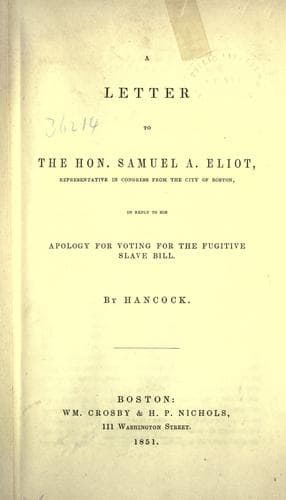
A Letter to the Hon. Samuel A. Eliot, Representative in Congress From the City of Boston, In Reply to His Apology For Voting For the Fugitive Slave Bill.Dexter, Franklin
Philosophy
A Letter to the Hon. Samuel A. Eliot, Representative in Congress From the City of Boston, In Reply to His Apology For Voting For the Fugitive Slave Bill.
Dexter, Franklin
Eliot, Samuel Atkins, 1798-1862; Fugitive slave law of 1850; Slavery -- United States
It seems, then, that the Virginian, in claiming an inhabitant of Boston
as his slave, in fact brings _a suit_ against him for services due worth
one thousand dollars. Now remember, Sir, the fugitive is not to be
delivered up, as a mass of flesh, or inanimate matter, belonging to the
claimant, but as a debtor, in the phraseology of your own law, "_owing_
service or labor." The suit is brought for service or labor _due_, and
the Constitution provides that the person so owing service or labor
shall be delivered to him to whom the same is "_due_." And now, is this
suit for service due "a suit at _common law_"? Again let the Supreme
Court answer. "The phrase _common law_, found in this clause [the clause
guaranteeing a jury trial], is used in contradistinction to equity and
admiralty and maritime jurisdiction. It is well known, that, in civil
causes in courts of equity and admiralty, juries do not intervene, and
that courts of equity use the trial by jury only in extraordinary cases,
to inform the conscience of the court. When, therefore, we find that the
amendment requires that the right of trial by jury shall be preserved in
suits at common law, the natural conclusion is, that this distinction
was present to the minds of the framers of the amendment. By _common
law_, they meant what the Constitution denominated, in the third
article, 'law'; not merely suits which the common law recognized among
its old and settled proceedings, but suits in which legal rights were to
be ascertained and determined, in contradistinction to those where
equitable rights alone were recognized, and equitable remedies were
administered.... In a just sense, the amendment, then, may be construed
to embrace _all suits_ which are not of equity and admiralty
jurisdiction, _whatever may be the peculiar form_ which they may assume
to settle legal rights." (3 _Peters_, 446.)
Public-domain text, read in full here on John Shaqi.
Reviews
Reviews
No reviews yet
Be the first to share your thoughts on this work.
Join the Discussion
Join the discussion
Sign in to leave a comment or review.
Sign InorCreate an account