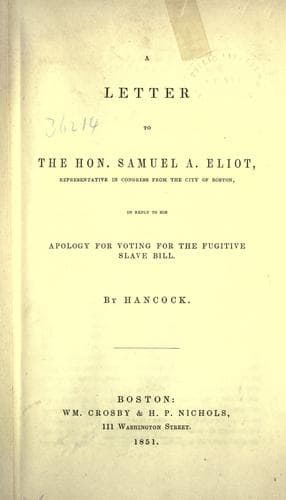
A Letter to the Hon. Samuel A. Eliot, Representative in Congress From the City of Boston, In Reply to His Apology For Voting For the Fugitive Slave Bill.Dexter, Franklin
Philosophy
A Letter to the Hon. Samuel A. Eliot, Representative in Congress From the City of Boston, In Reply to His Apology For Voting For the Fugitive Slave Bill.
Dexter, Franklin
Eliot, Samuel Atkins, 1798-1862; Fugitive slave law of 1850; Slavery -- United States
4. The last condition on which the Union can be preserved is,--"No State
shall be prevented from coming into the Union on the ground of having
slavery." This is an unkind cut at Mr. Webster, since he has again and
again pledged himself against the admission of slave States. Even so
early as 1819, he advocated, in a public meeting at Boston, a resolution
declaring that Congress "possessed the constitutional power, upon the
admission of any new State created beyond the limits of the original
territory of the United States, to make the prohibition of the further
extension of slavery or involuntary servitude in such new State a
condition of admission. That, in the opinion of this meeting, it is just
and expedient that this power should be exercised by Congress upon the
admission of all new States created beyond the original limits of the
United States." In his New York speech, in 1837, he averred, "When it is
proposed to bring new members into the political partnership, the old
members have a right to say on what terms such new partners are to come
in, and _what they are to bring along with them_." In his Springfield
speech, he insisted, "There is no one [he forgot Mr. Foote and his other
Southern friends] who can complain of the North for resisting the
increase of _slave representation_, because it gives power to the
minority in a manner inconsistent with the principles of our
government." So late as 1848, he proclaimed on the floor of the Senate,
"I shall oppose all such extension [slave representation] at all times
and under all circumstances, even against all inducements, against all
combinations, against all compromises."
The State of Georgia, in her convention of December last, added a
_fifth_ condition to those stated by Mr. Foote as indispensable to the
preservation of the Union, viz.:--"No act suppressing the slave-trade
between the slaveholding States." Unfortunately for Mr. Webster, he is
here, for the fifth time, virtually held up as a disorganizer, and an
enemy of the Union; for in his speech in the Senate (6th February, 1837)
he remarked,--"As to the point, the right of regulating the transfer of
slaves from one State to another, he did not know that he entertained
any doubt, because the Constitution gave Congress the right to regulate
trade and commerce between the States. Trade in what? In whatever was
the subject of commerce and ownership. If slaves were the subjects of
ownership, then trade in them between the States was subject to the
regulation of Congress."
Public-domain text, read in full here on John Shaqi.
Reviews
Reviews
No reviews yet
Be the first to share your thoughts on this work.
Join the Discussion
Join the discussion
Sign in to leave a comment or review.
Sign InorCreate an account