Great Britain -- History -- Anglo-Saxon period, 449-1066 -- Sources
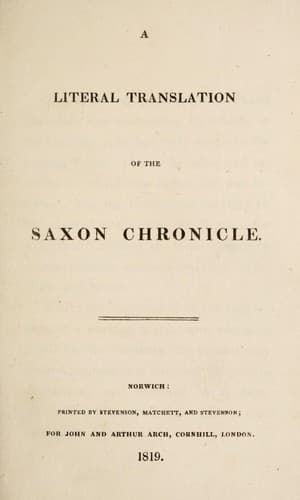
A
LITERAL TRANSLATION
OF THE
SAXON CHRONICLE.
[Illustration]
NORWICH:
PRINTED BY STEVENSON, MATCHETT, AND STEVENSON;
FOR JOHN AND ARTHUR ARCH, CORNHILL, LONDON.
1819.
The following version of the Saxon Chronicle was undertaken by a Lady
in the Country, who had only access to the printed Texts. It was far
advanced towards its completion before she was informed, that the
Public was speedily to be indebted to the Rev. Mr. Ingram, for a
Collated Edition of these singularly valuable Annals, accompanied by a
Translation and Notes.
Under the expectation of the appearance of a work so much more complete
in all its circumstances, the present very limited impression is
intended for private circulation, and executed in a form, which, it is
conceived, may render it convenient for reference.
THE
SAXON CHRONICLE.
The island Britain is 800 miles long, and 200 broad, and there are in
this island five nations, English, Britons or Welch, Scots, Picts, and
Romans. The Britons were the first inhabitants of the land; they came
from Armenia, and first settled in the south of Britain; afterwards
it fell out that the Picts came from the south of Scythia, with long
ships, but not many, and they first landed in the north of Ireland,
and they entreated the Scots that they might abide there, and they
would not permit them; but the Scots said to them, We may nevertheless
give you counsel; we know another island eastward of this, there you
may live if you will, and if any withstand you, we will aid you that
you may conquer it. Then the Picts departed, and came to the northern
part of this land, for southward the Britons possessed it, as we said
before. And the Picts took wives of the Scots, on condition that they
should always choose their Royal lineage on the woman’s side, and they
observed this custom long after. And it happened, in the course of
years, that a division of the Scots passed from Ireland into Britain,
and conquered some part of this land, and their leader was called
Reoda; from him they are named the Dælreodi. Sixty years before Christ
was born, Caius Julius, the Roman Emperor, came to Britain with 80
ships. He was at first overcome in a terrible battle, and lost great
part of his army, and he left the remainder of his forces to abide
with the Scots, and went into Gaul, and there he collected 600 ships,
with which he returned to Britain, and at the first onset Cæsar’s
lieutenant, named Labienus, was slain. Then the Britons took large and
sharp stakes, and drove them into the fording place of a certain river,
under the water; this river was called the Thames. When the Romans
discovered this, they would not go over the ford: then the Britons fled
to the wood fastnesses, and the Emperor conquered very many of their
chief towns by great battles, and he passed again into Gaul.
1.
Public-domain text, read in full here on John Shaqi.
Reviews
Reviews
No reviews yet
Be the first to share your thoughts on this work.
Join the Discussion
Join the discussion
Sign in to leave a comment or review.
Sign InorCreate an account