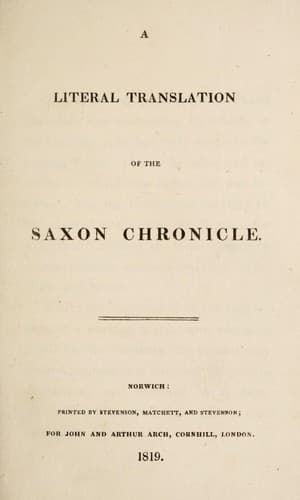
Great Britain -- History -- Anglo-Saxon period, 449-1066 -- Sources
This year the Army again sailed round into the Thames, and came up the
Medway as far as Rochester. And the Kentish troops marched against
them, and fought with them bravely: but too soon, alas! they gave way
and fled, because they had not the support which they ought to have
had. Then the Danes kept possession of the field of battle, and having
seized horses they rode far and wide wherever they chose, and they
plundered and laid waste nearly all the western part of Kent. Then the
King with his Witan resolved that both a fleet and an army should be
sent against them; but when the ships were ready, they delayed them
from day to day, and oppressed the miserable people who served in them.
And whenever the ships were going to sail, they were always stopped
from time to time, and they allowed the enemy’s forces to increase
continually, and whenever these retired from the coast, they then went
forth after them. In the end this fleet served no purpose, but to weary
the men, to waste money, and to encourage the enemy.
1000.
This year the King went into Cumberland and laid waste nearly the whole
of it; and his ships attempted to get round Chester, and were to have
met him, but they were not able; then they plundered Mænige (Anglesey).
And the enemy’s fleet sailed this summer to the dominions of Richard.
1001.
This year the peace of England was much disturbed by the pirates, who
plundered and burned in all parts; and thus they proceeded in one
course until they came to Æthelinga-dene (Alton), and there the men of
Hampshire met them, and fought with them. And the King’s High Sheriff
Ethelweard was killed there, and Leofric of Whitechurch, and Leofwine
the King’s High Sheriff, and Wulfhere the Bishop’s Thane, and Godwin of
Weorthig (Worthing?) the son of Bishop Ælfsig, and there fell 81 men
in all. And many more were slain on the part of the Danes, although
they kept possession of the field of battle. And thence they proceeded
northward until they came into Devon, and there Pallig joined them
with all the ships that he could collect, for he had deserted from
King Ethelred after all the assurances of fidelity which he had given
him, and although the King had been very bountiful to him, in gifts
of houses, of gold, and of silver. And they burned Tegnton (Teynton),
and many other good villages which we cannot name, and afterwards the
people of that country made a treaty with them; and they departed
thence to Exmouth, and so they went on in one course until they came
to Peonnho (Pen), and there Cola the King’s High Sheriff, and Eadsige
the King’s Sheriff, came against them with the troops which they had
gathered together, but they were put to flight and many were slain, and
the Danes kept possession of the field of battle. And the next morning
they burned the villages of Pen and of Clifton, and many good villages
besides which we cannot name. And then they proceeded eastward until
they arrived at Wight, and in the morning they there burned the village
Public-domain text, read in full here on John Shaqi.
Reviews
Reviews
No reviews yet
Be the first to share your thoughts on this work.
Elsewhere in the archive
Join the Discussion
Join the discussion
Sign in to leave a comment or review.
Sign InorCreate an account