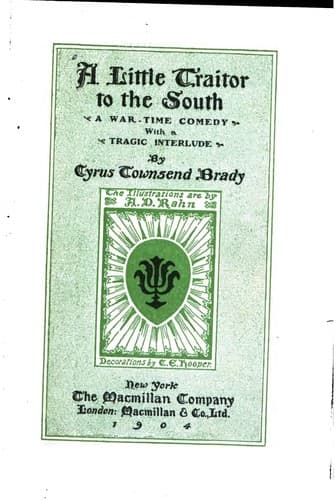
A Little Traitor to the South: A War Time Comedy with a Tragic InterludeBrady, Cyrus Townsend
History
A Little Traitor to the South: A War Time Comedy with a Tragic Interlude
Brady, Cyrus Townsend
United States -- History -- Civil War, 1861-1865 -- Fiction
"No. The thing sometimes works. Glassell got out alive when he tried to
blow up the _New Ironsides_, and anyway, I want this chance. I have had
four years of war and have spent three of it in prison. For God's sake,
General--"
"Very well. You shall have it," answered Beauregard, "but I will not
have the boat used as a submarine. You can sink her until her hatch is
awash, but no lower."
"Thank you," answered the delighted Sempland; "where shall I get a
crew?"
"One has already been selected from among hundreds who volunteered.
Five seamen are to attend to the propeller and an artillery officer to
look after the torpedo. You can steer the boat?"
"I lived on the water before I entered the army."
"All right. The _Wabash_ is lying off the Main Ship Channel. I have no
instructions to give you except to go at her and sink her. I am told
the most vulnerable spot of a ship is just forward of the mainmast. Hit
her there. Don't explode your torpedo until you are in actual contact
if possible. Glassell's went off the moment he saw her without
touching, else he would have sunk the _New Ironsides_. You will find
the torpedo boat at the government wharf. Everything is ready. You will
leave at seven. The three blockade-runners will follow you as close as
is practicable, and when you torpedo the frigate they will dart through
the Swash and try to get to sea. I reckon upon the other Yankee ships
running down to aid the _Wabash_. I'll see you on the wharf. God bless
you, and may He have mercy on your souls!" said the little general,
solemnly.
He put out his hand to the young man, and Sempland shook it vigorously.
"I pray that I may succeed for the sake of the South, sir," returned
the young man, firmly.
"For the sake of the South, gentlemen. That is our watchword," cried
Beauregard, standing up and bringing his hand to a salute.
"Have you any preparations to make, Sempland?" asked Lacy, when they
left the office.
"I have a letter to write."
"Very well. I will look after the boat and will meet you on the wharf.
Shall you see Miss Glen before you go?"
"No."
"You must."
"I cannot. What difference does it make to her, anyway? I will be at
the wharf"--he looked at his watch, it was already six o'clock--"in
three-quarters of an hour. Good-by."
The two men shook hands and separated.
"The boat is ready," said Lacy to himself. "I saw to that this
afternoon. There is nothing for me to do there. I wonder--by Jove, I'll
do it!"
A few minutes after he was ushered again into the presence of Miss
Fanny Glen. She had at first pleaded indisposition, but he had insisted
upon seeing her.
"I have something of so much importance to tell you, Miss Glen," he
began, as she entered the room, "that I was forced to override your
desires."
"Is it about the subject that we--I--talked about this afternoon? If
so--"
"It is not. I shall say no more on that score. I had my answer then."
"I am very sorry," continued the girl. "I admire you, respect you,
but--but--I do not--"
Public-domain text, read in full here on John Shaqi.
Reviews
Reviews
No reviews yet
Be the first to share your thoughts on this work.
Join the Discussion
Join the discussion
Sign in to leave a comment or review.
Sign InorCreate an account