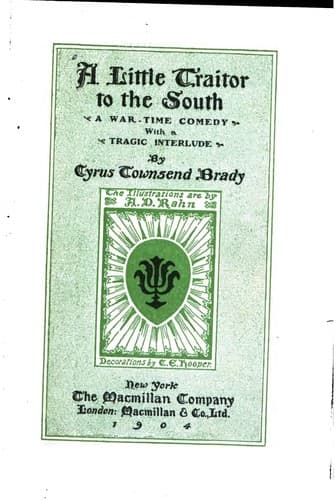
A Little Traitor to the South: A War Time Comedy with a Tragic Interlude — John Shaqi
A Little Traitor to the South: A War Time Comedy with a Tragic InterludeBrady, Cyrus Townsend
History
A Little Traitor to the South: A War Time Comedy with a Tragic Interlude
Brady, Cyrus Townsend
United States -- History -- Civil War, 1861-1865 -- Fiction
She was painted a slate-gray, and her ballast was so adjusted that with
the seven men who manned her on board, one to steer, one to look after
the torpedo, and five to turn the propeller crank, her low hatch
scarcely rose above the water. In that condition, and especially at
night, she looked like a plank floating on the surface. By hard and
conscientious labor her five man-power engine could shove her along at
about a speed of four knots. Although the order of General Beauregard
that she should not be submerged again had materially diminished the
risk which experience had shown was overwhelming, yet the proposed
expedition was nevertheless hazardous in the extreme.
In the first place, an excellent lookout was kept on the Union ships on
account of the several attempts which had been made against them by
similar boats. If she were discovered, one shot striking the boat as
she approached, even a rifle shot, would suffice to sink her. No one
knew what she would do even if she succeeded in exploding the torpedo.
It was scarcely hoped that she could get away from a sinking ship
in that event.
The little party of officers grouped on the wharf bade good-by to the
men who entered the deadly affair as if they were saying farewell to
those about to die. Every preparation had been made, the artillery
officer had finally and carefully inspected the torpedo to see if it
was in good working order, the men had descended into the cramped
narrow little hull of the boat and had made ready to start the
propeller. None of them wore any superfluous clothing, for it was
oppressively hot in the confined area of the little iron shell, and
they might have to swim for their lives anyway--perhaps they would be
lucky if they got the chance. In short, everybody was ready and every
one was there except the commander of the expedition.
Great secrecy had been observed in the preparations lest there might be
a spy in the town, who, learning of the attempt, would communicate the
valuable information to the Federal fleet, and so frustrate it. General
Beauregard had caused the wharf to be cleared and guarded early in the
evening. It was quite dark in February at six o'clock, and no one
except his trusted staff officers and Lacy, who had so magnanimously
surrendered his opportunity to Sempland, was present.
At a quarter before seven, which was the time Sempland had appointed to
return when he left in obedience to Fanny Glen's summons, the general
began to feel some uneasiness. He spoke about it to Lacy, but was
reassured by that gentleman, who professed full confidence that the
young lieutenant would undoubtedly be there in a few moments. He had
already of his own motion despatched a soldier to Fanny Glen's house
and had learned from him the false news that Sempland had been there
and had left. Lacy supposed he had returned to his quarters.
Public-domain text, read in full here on John Shaqi.
Reviews
Reviews
No reviews yet
Be the first to share your thoughts on this work.
Join the Discussion
Join the discussion
Sign in to leave a comment or review.
Sign InorCreate an account