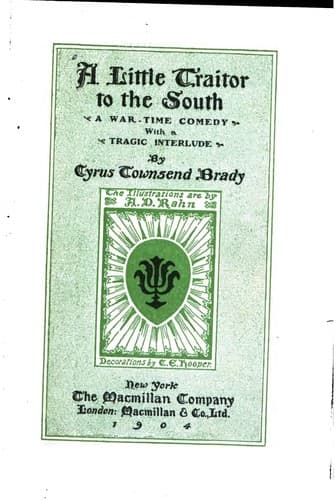
A Little Traitor to the South: A War Time Comedy with a Tragic InterludeBrady, Cyrus Townsend
History
A Little Traitor to the South: A War Time Comedy with a Tragic Interlude
Brady, Cyrus Townsend
United States -- History -- Civil War, 1861-1865 -- Fiction
The anger that Miss Fanny Glen felt at this particular moment gave her
a temporary reassurance as to some questions which had agitated
her--how much she cared, after all, for Lieutenant Rhett Sempland, and
did she like him better than Major Harry Lacy? Both questions were
instantly decided in the negative--for the time being. She hated Rhett
Sempland; _per contra_, at that moment, she loved Harry Lacy. For
Harry Lacy was he about whom the difference began. Rhett Sempland,
confident of his own affection and hopeful as to hers, had attempted,
with masculine futility and obtuseness, to prohibit the further
attentions of Harry Lacy.
Just as good blood, _au fond_, ran in Harry Lacy's veins as in Rhett
Sempland's, but Lacy, following in the footsteps of his ancestors, had
mixed his with the water that is not water because it is fire.
He "crooked the pregnant hinges" of the elbow without cessation, many a
time and oft, and all the vices--as they usually do--followed _en
train_. One of the oldest names in the Carolinas had been dragged in
the dust by this latest and most degenerate scion thereof. Nay, in that
dust Lacy had wallowed--shameless, persistent, beast-like.
To Lacy, therefore, the Civil War came as a godsend, as it had to many
another man in like circumstances, for it afforded another and more
congenial outlet for the wild passion beating out from his heart. The
war sang to him of arms and men--ay, as war has sung since Troia's day,
of women, too.
He did not give over the habits of a lifetime, which, though short, had
been hard, but he leavened them, temporarily obliterated them even, by
splendid feats of arms. Fortune was kind to him. Opportunity smiled
upon him. Was it running the blockade off Charleston, or passing
through the enemy's lines with despatches in Virginia, or heading a
desperate attack on Little Round Top in Pennsylvania, he always won the
plaudits of men, often the love of women. And in it all he seemed to
bear a charmed life.
When the people saw him intoxicated on the streets of Charleston that
winter of '63 they remembered that he was a hero. When some of his more
flagrant transgressions came to light, they recalled some splendid feat
of arms, and condoned what before they had censured.
He happened to be in Charleston because he had been shot to pieces at
Gettysburg and had been sent down there to die. But die he would not,
at least not then. Ordinarily he would not have cared much about
living, for he realized that, when the war was over, he would speedily
sink back to that level to which he habitually descended when there was
nothing to engage his energies; but his acquaintance with Miss Fanny
Glen had altered him.
Public-domain text, read in full here on John Shaqi.
Reviews
Reviews
No reviews yet
Be the first to share your thoughts on this work.
Join the Discussion
Join the discussion
Sign in to leave a comment or review.
Sign InorCreate an account