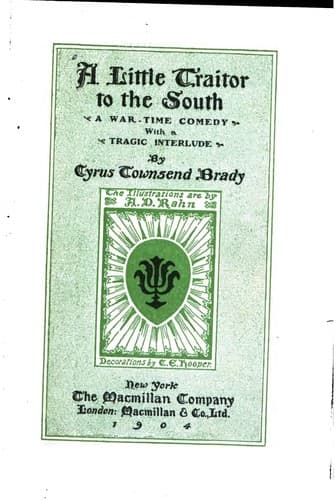
A Little Traitor to the South: A War Time Comedy with a Tragic InterludeBrady, Cyrus Townsend
History
A Little Traitor to the South: A War Time Comedy with a Tragic Interlude
Brady, Cyrus Townsend
United States -- History -- Civil War, 1861-1865 -- Fiction
"Miss Fanny," he began gently--the war had brought the general and the
brave girl very close together--"I was coming over to see you in a
little while. You have shown yourself a brave little woman many times.
You need all your courage now."
"Yes, General," said the girl, faintly, "I know."
"You have sustained a terrible loss."
"Is--is--Mr. Sempland--?"
"He is well enough at present. I refer to your friend, Major Lacy."
"Is he--?"
"I am sorry to say that in all probability he has lost his life in the
torpedo boat. We can get no tidings of her or of any of her crew. She
must have sunk with the ship."
"Did they succeed, sir?" interrupted Fanny Glen with an anxiety and an
apprehension too great to be controlled.
"They did," returned Beauregard, somewhat surprised at her question,
"but the torpedo boat, I think, went down with the ship she blew up; at
any rate no one has seen her or any of her crew since the explosion. I
knew that it was almost certain death to them."
Fanny Glen sank back in the chair. She almost lost consciousness in her
agony. She murmured strange and incoherent words. The general did not
understand them, but he rose, came to her side, bent over her and took
her hand, patting it softly.
"I know, I know, my dear child," he said gently, "how you must suffer.
Many another woman has had to give up her heart's desire for our
beloved country. Think of the service he rendered, to you and to all of
us! Think of his noble sacrifice, his death! Cherish his memory and be
proud that he loved you and that you loved him. Few women have done
more for the South than you, and there is still much to do. Work will
assuage your grief," continued the general, laying his hand tenderly
upon the bowed head. "You will always have the deathless memory of his
heroism."
"Oh!" cried the woman, throwing back her head, "you are wrong. You do
not know, you do not understand. I honored Major Lacy, I rejoiced in
his courage, but I did not love him. It is not he that I think of. It
is my father."
"Your father? What do you mean?"
"Admiral Vernon."
"What!"
"Yes, he is my father. My name is Fanny Glen Vernon."
"Good heavens! It cannot be possible."
"It is true. My mother was a Southern woman, one of the Glens of
Halifax--"
"I knew her!" exclaimed Beauregard.
"She died when I was a child, and I was brought up by her sister. My
father--I did not see much of him. He was a sailor, and after my
mother's death he sought constantly to be in active service. When the
war broke out he said he must stand by the old flag. I strove to
persuade him differently. It was horrible to me, to think that a son of
South Carolina, and my father, would fight against her. There was a
quarrel between us. I told my father I would not acknowledge him any
longer. I repudiated the Vernon name and came here and worked for the
South, as you know. When I learned yesterday that you were going to
blow up the _Wabash_--"
Public-domain text, read in full here on John Shaqi.
Reviews
Reviews
No reviews yet
Be the first to share your thoughts on this work.
Join the Discussion
Join the discussion
Sign in to leave a comment or review.
Sign InorCreate an account