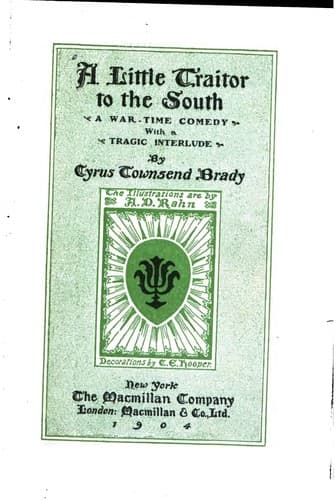
A Little Traitor to the South: A War Time Comedy with a Tragic InterludeBrady, Cyrus Townsend
History
A Little Traitor to the South: A War Time Comedy with a Tragic Interlude
Brady, Cyrus Townsend
United States -- History -- Civil War, 1861-1865 -- Fiction
Slowly she felt herself being drawn nearer to him. She struggled
feebly, glad to be overborne by his superior strength. In another
moment she was in his arms for the second time. Her head was bent down
toward his waistcoat pocket. Holding her safe with one arm he put his
hand under her chin, and turned her face upward. There were blushes on
her cheeks, laughter and tears in her eyes. The interrupted kiss
trembled upon her lips, and he--well, this time it was longer than the
night before and more satisfying. As he kissed her her arms went around
his neck again.
"There was no other man," she whispered, "there never was any one but
you. I did wrong, very wrong, but my father and you--that was my
excuse. And I loved you all the time."
When there was opportunity some moments later for articulate
conversation, he endeavored to solve the mystery of her paternity, the
understanding of which he had put by in the face of more pressing
business--or pleasure.
"Then your name isn't Fanny Glen?"
"That's part of it."
"What's the rest of it?"
"Fanny Glen Vernon."
"What! Is Admiral Vernon your father?"
"He is."
"How is that?"
"When the war broke out he stayed with the North, was true to his flag,
he said. I had seen little of him since my mother's death, when I was
ten years old. I was a Southern woman. It seemed monstrous to me. I
begged and implored him, but uselessly, and finally our relations were
broken off. So I dropped the name of Vernon, and came here to work for
our cause, the rest you know. But I could not let him be blown up
unsuspecting, could I? If he were killed in action, it would be
terrible enough, but this was a dreadful ending. I thought--I don't
know what I thought. I love the South, but--"
"I understand, my dearest," he said, in no condition to understand
anything very clearly, and caring little for the moment for anything
except that she loved him.
"And you forgive me?"
"Forgive you? With all my soul. This moment with you in my arms, with
your arms around my neck, with your kisses upon my lips, with your
words in my ear, with your love in my heart--this makes up for
everything! I shall go to my death gladly."
"To your death!" she exclaimed, drawing away from him in surprise and
alarm.
"Yes. Your confession to me makes no difference."
"But I will tell the general."
"I forbid it! Darling, you have committed an act of treason to the
South, and while your love for your father--and for me--has explained
it, you could not make such a plea as that before any court-martial
composed of soldiers. You would only harm yourself, and you would not
help me, and so I won't allow it."
"But I must tell the general!" she persisted.
"Dearest, no," said Sempland, smiling fondly at her. "We will
anticipate what might have been. If all had gone well, you would have
promised to obey me before the altar. Would you not?"
She nodded with astonishing docility.
"Well, then--"
"And if I will not?"
Public-domain text, read in full here on John Shaqi.
Reviews
Reviews
No reviews yet
Be the first to share your thoughts on this work.
Join the Discussion
Join the discussion
Sign in to leave a comment or review.
Sign InorCreate an account