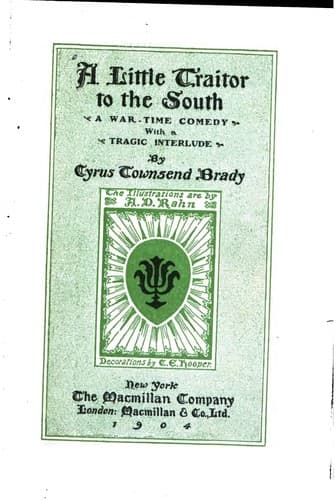
A Little Traitor to the South: A War Time Comedy with a Tragic Interlude — John Shaqi
A Little Traitor to the South: A War Time Comedy with a Tragic InterludeBrady, Cyrus Townsend
History
A Little Traitor to the South: A War Time Comedy with a Tragic Interlude
Brady, Cyrus Townsend
United States -- History -- Civil War, 1861-1865 -- Fiction
"Gentlemen," said Beauregard, turning to his staff officers, "you know
the story of last night. How this lady interfered to prevent an
important military manoeuvre, the object of which was the destruction
of the Federal flagship by a torpedo, and incidentally the probable
death of Captain Sempland. Such conduct is essentially treasonable,
especially in a state of war. What is the punishment for such actions
in the face of the enemy?"
"Death, sir," returned the adjutant-general, solemnly.
"Are you all agreed as to that, gentlemen?"
"We are, sir," was the unanimous reply.
They had been well tutored in the little comedy which the general had
arranged, it was evident.
"Impossible, sir!" cried Sempland, in agony. They deceived even him
with their seriousness. "This is most irregular! I protest--"
"I am ready, gentlemen," whispered Fanny Glen, bravely, turning very
white as she spoke, and not appearing at all ready in fact, "I--I--am
glad to--suffer, since Captain Sempland--" she faltered with a
miserable attempt at courage.
"One moment, please," broke in the little general, imperatively. "But,
gentlemen, the culprit has otherwise deserved well of her country, as
you know. During the war her services in the general hospital have been
beyond price. She is a woman. On the ship which it was proposed to blow
up was her father, Admiral Vernon, a South Carolinian, whose ideas of
duty led him to continue his services to the United States. These are
mitigating circumstances. Here is no treachery to the South, merely a
woman's desire to save her father from a swift and sudden death. No
mischance has arisen from her action. Major Lacy took out the boat with
his usual distinction, although, fortunately for the lady and the
admiral, the _Housatonic_ seems to have suffered instead of the
_Wabash_. Under these circumstances, I think, it does not behoove us to
be too severe. You agree with me, I am sure, gentlemen?"
"Certainly, sir, we do," replied the officers in chorus.
"Thank you! thank you!" exclaimed Fanny Glen, gratefully, with
boundless relief in her voice.
By this time she was as close to Sempland as she could get, and
entirely unconscious of what he was doing, the latter had thrown his
arm protectingly around her waist.
"Wait, Miss Glen," said the general, severely, lifting his hand and
checking her further speech, "you cannot think to escape scot free.
Such actions cannot go entirely unpunished. So long as Miss Fanny Glen
exists she must suffer for her actions. You are agreed with me,
gentlemen?"
"We are, sir."
It was remarkable the unanimity with which they all supported their
general's decisions on so serious a matter, and practically without
deliberation.
"Captain Sempland, as a soldier, I am sure you will acquiesce in the
views of your brother officers."
Sempland bit his lip. Fanny Glen nestled closer to him and looked up at
him beseechingly.
"Oh, General!" he said at last. "Isn't there some way out of it?"
Public-domain text, read in full here on John Shaqi.
Reviews
Reviews
No reviews yet
Be the first to share your thoughts on this work.
Join the Discussion
Join the discussion
Sign in to leave a comment or review.
Sign InorCreate an account