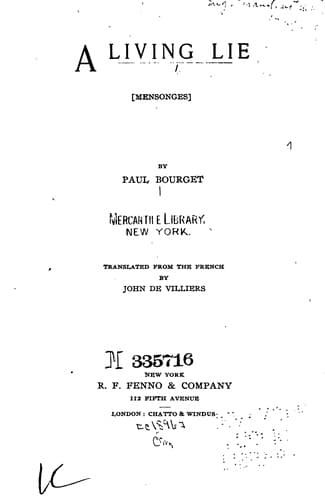
A LIVING LIE
(MENSONGES)
BY
PAUL BOURGET
TRANSLATED FROM THE FRENCH
BY
JOHN DE VILLIERS
NEW YORK
R. F. FENNO & COMPANY
112 FIFTH AVENUE
LONDON: CHATTO & WINDUS
CONTENTS
I. A Provincial Corner of Paris
II. Simple Souls
III. A Lover and a Snob
IV. The 'Sigisbée'
V. The Dawn of Love
VI. An Observer's Logic
VII. The Face of a Madonna
VIII. The Other Side of the Picture
IX. An Actress in Real Life
X. In the Toils
XI. Declarations
XII. Cruel to be Kind
XIII. At Home
XIV. Happy Days
XV. Colette's Spite
XVI. The Story of a Suspicion
XVII. Proofs
XVIII. The Happiest of the Four
XIX. All or Nothing
XX. The Abbé Taconet
MY DEAR DE VILLIERS,
In the first place, you must let me thank you for having undertaken the
task of introducing 'Mensonges' to the English-reading public; and also
express the hope that this novel, which is no longer new, may not cause
a recurrence of that misconception which too often arises when a work
written in and for a Latin country is suddenly transplanted to
Anglo-Saxon soil.
One of the most grievous results of such misconception, and one which
French writers--I speak from experience--feel most keenly, is the
reproach of immorality. Balzac spent a lifetime in defending himself
against that charge; so it was with Flaubert; so it is with Emile Zola.
I well remember how hurt I felt myself when, in the course of an action
brought some ten years since against a publishing firm in London--who
had, by the way, issued a translation of the work without my
permission--'Un Crime d'Amour' was harshly spoken of by one of your
judges. Not only then, but on many occasions, have I had an opportunity
of remarking that the English regard the novelist's art from a
standpoint differing entirely from that taken up by French writers. That
difference is well worth dwelling upon here, for the problem it raises
is neither more nor less than the problem of the whole art of
novel-writing.
To French writers--and I refer more particularly to the great school
which follows Balzac and Stendhal--the first quality of that art is
analytical precision. Balzac called himself 'a doctor of social
sciences.' Stendhal-Beyle, when asked his profession, used to reply,
'Observer of the human heart'; and upon the title-page of 'Rouge et
Noir' he wrote as a motto the significant words, 'The truth, the ugly
truth.' Every word of Flaubert's correspondence breathes forth the
conviction that the novelist must always and before all else paint life
as it is. These writers and their disciples do but follow, consciously
or unconsciously, the scientific movement of the age. They are
sociologists and psychologists who write in an imaginative form. The
attitude they usually take up towards the object they are studying is
explained by the fact that, as analysts, they are obliged to assume that
absolute indifference to morality or immorality which should animate
every _savant_ whilst pursuing his investigations.
Public-domain text, read in full here on John Shaqi.
Reviews
Reviews
No reviews yet
Be the first to share your thoughts on this work.
Join the Discussion
Join the discussion
Sign in to leave a comment or review.
Sign InorCreate an account