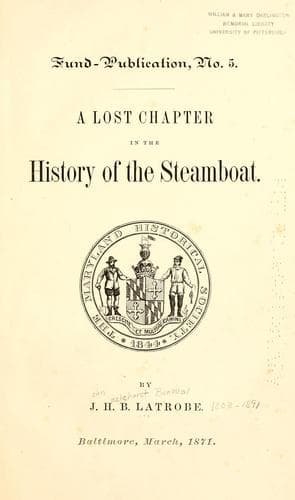
A Lost Chapter in the History of the SteamboatLatrobe, John H. B. (John Hazlehurst Boneval)
History
A Lost Chapter in the History of the Steamboat
Latrobe, John H. B. (John Hazlehurst Boneval)
Roosevelt, Nicholas J., 1767-1854; Steam-navigation -- History
“Sir: I have received yours of the 30th September, in which you
_propose to communicate to me_ the principles of an invention which
you say you have discovered respecting the moving of ships by the
means of steam. It is a subject on which I have made important
discoveries. I shall be glad to receive the communication which _you
intend_, as I have made the principles of mechanics my particular
study, &c.” (There are no words italicised in the original. L.)
Certainly, it is only necessary to read this letter to be satisfied,
that the one to which it is a reply, and it is not suggested that Mr.
Fulton ever wrote another, could not have described the combination
which made the steamboat the thing that it now is: or that it could have
been accompanied by drawings shewing the plan finally adopted,—the
Roosevelt plan, going back as far as 1782, and described in practical
detail in the letter of 21st October, 1798.
It is true that Mr. Fulton obtained letters patent of the United States
for his steamboat in 1809—in reference to which Mr. Colden says, as
though to corroborate Fulton’s claim as inventor,
“They (the Chancellor and Mr. Fulton) entered into a contract, by
which it was, among other things, agreed that a patent should be taken
out in the United States in Mr. Fulton’s name, which Mr. Livingston
well knew could not be done without Mr. Fulton _taking an oath that
the improvement was solely his_.”
And a patent was in fact taken out, in those days when patents were had
for the asking, and when none of that examination, which now protects
the public, was required by law.
We have already seen, in the case stated for Mr. Wirt’s opinion, the
allegation that Fulton neither subscribed nor swore to the
specification; and that the name Robert Fulton was in the handwriting of
another man. Unless this had been the fact, it would hardly have been
alleged in a paper, prepared for the opinion of eminent counsel. But I
have before me an original letter dated Trenton, January, 1815,
addressed to Mr. Roosevelt by Delacy, in which the latter gives an
account of the proceedings before the Legislature, and in which is this
sentence:
“Fulton has the effrontery to avow his having got Fletcher to sign his
name and makes light of it, as if he was entitled to violate the laws,
as well as private rights, at pleasure.”
It is true, this is the letter of a partizan in a struggle before the
Legislature. Still, the matter of fact would not be misstated in a
private correspondence, where there was no conceivable motive to
mislead.
The committee of the Legislature finally reported, and very wisely, that
it was inexpedient to make any special provision in connection with the
matter in controversy before that body.
Public-domain text, read in full here on John Shaqi.
Reviews
Reviews
No reviews yet
Be the first to share your thoughts on this work.
Join the Discussion
Join the discussion
Sign in to leave a comment or review.
Sign InorCreate an account