United States -- Social life and customs -- 19th century -- Fiction
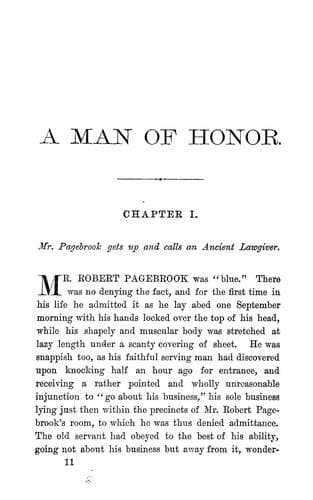
It was clear that Mr. Robert Pagebrook's reflections were anything but
pleasant as he lay there thinking, thinking, thinking--resolving not to
think and straightway thinking again harder than ever. His disturbance
was due to a combination of causes. His muddy boots were in full view
for one thing, and he was painfully conscious that they were not likely
to get themselves blacked now that he had driven old Moses away. This
reminded him that he had showed temper when Moses's meek knock had
disturbed him, and to show temper without proper cause he deemed a
weakness. Weaknesses were his pet aversion. Weakness found little
toleration with him, particularly when the weakness showed itself in his
own person, out of which he had been all his life chastising such
infirmities. His petulance with Moses, therefore, contributed to his
annoyance, becoming an additional cause of that from which it came as an
effect.
Our young gentleman acknowledged, as I have already said, that he was
out of spirits, and in the very act of acknowledging it he contemned
himself because of it. His sturdy manhood rebelled against its own
weakness, and mocked at it, which certainly was not a very good way to
cure it. He denied that there was any good excuse for his depression,
and scourged himself, mentally, for giving way to it, a process which
naturally enough made him give way to it all the more. It depressed him
to know that he was weak enough to be depressed. To my thinking he did
himself very great injustice. He was, in fact, very unreasonable with
himself, and deserved to suffer the consequences. I say this frankly,
being the chronicler of this young man's doings and not his apologist by
any means. He certainly had good reason to be gloomy, inasmuch as he had
two rather troublesome things on his hands, namely, a young man without
a situation and a disappointment in love, or fancy, which is often
mistaken for love. A circumstance which made the matter worse was that
the young man without a situation for whose future Mr. Robert Pagebrook
had to provide was Mr. Robert Pagebrook himself. This alone would not
have troubled him greatly if it had not been for his other trouble; for
the great hulking fellow who lay there with his hands clasped over his
head "cogitating," as he would have phrased it, had too much physical
force, too much of good health and consequent animal spirits, to
distrust either the future or his own ability to cope with whatever
difficulties it might bring with it. To men with broad chests and great
brawny legs and arms like his the future has a very promising way of
presenting itself. Besides, our young man knew himself well furnished
for a fight with the world. He knew very well how to take care of
himself. He had done farm labor as a boy during the long summer
vacations, a task set him by his Virginian father, who had carried a
brilliant intellect in a frail body to a western state, where he had
Public-domain text, read in full here on John Shaqi.
Reviews
Reviews
No reviews yet
Be the first to share your thoughts on this work.
Join the Discussion
Join the discussion
Sign in to leave a comment or review.
Sign InorCreate an account