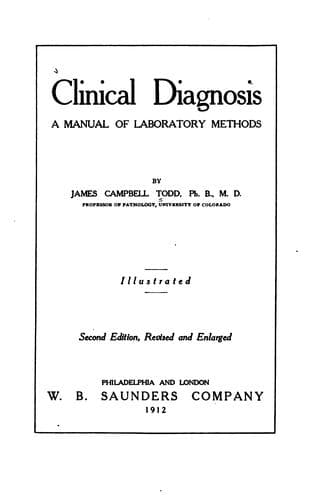
A Manual of Clinical DiagnosisTodd, James Campbell
Science
A Manual of Clinical Diagnosis
Todd, James Campbell
Diagnosis, Laboratory
(_b_) _Changes in circulation in the kidney_, either anemia or
congestion, as in excessive exercise, chronic heart disease, and
pressure upon the renal veins. The quantity of albumin is usually, but
not always, small. Its presence is constant or temporary, according to
the cause. Most of the causes, if continued, will produce organic
changes in the kidney.
(_c_) _Organic Changes in the Kidney_.--These include the inflammatory
and degenerative changes commonly grouped {71} together under the name
of nephritis, and also renal tuberculosis, neoplasms, and cloudy
swelling due to irritation of toxins and drugs. The amount of albumin
eliminated in these conditions varies from minute traces to 20 gm., or
even more, in the twenty-four hours, and, except in acute processes,
bears little relation to the severity of the disease. In acute and
chronic parenchymatous nephritis the quantity is usually very large.
In chronic interstitial nephritis it is small--frequently no more than
a trace. It is small in cloudy swelling from toxins and drugs, and
variable in renal tuberculosis and neoplasms. In amyloid disease of
the kidney the quantity is usually small, and serum-globulin may be
present in especially large proportion, or even alone. Roughly
distinctive of serum-globulin is the appearance of an opalescent cloud
when a few drops of the urine are dropped into a glass of distilled
water.
_Detection of albumin_ depends upon its coagulation by chemicals or
heat. There are many tests, but none is entirely satisfactory, because
other substances as well as albumin are precipitated. The most common
source of error is mucin. The tests given here are widely used and can
be recommended. They make no distinction between serum-albumin and
serum-globulin. They are given as nearly as possible in order of their
delicacy.
It is very important that urine to be tested for albumin be rendered
clear by filtration or centrifugation. This is too often neglected in
routine work. When ordinary methods do not suffice, it can usually be
cleared by shaking up with a little magnesium carbonate and filtering.
* * * * *
(1) Trichloracetic Acid Test.--The reagent consists of a saturated
aqueous solution of trichloracetic acid to which {72} magnesium
sulphate is added to saturation. A simple saturated solution of the
acid may be used, but addition of magnesium sulphate favors
precipitation of globulin, and by raising the specific gravity, makes
the test easier to apply.
Take a few c.c. of the reagent in a test-tube or conical test glass,
hold the tube or glass in an inclined position, and run the urine
gently in by means of a pipet, so that it will form a layer on top of
the reagent without mixing with it. If albumin be present, a white,
cloudy ring will appear where the two fluids come in contact. The ring
can be seen most clearly if viewed against a black background, and one
side of the tube or conical glass may be painted black for this
purpose.
Public-domain text, read in full here on John Shaqi.
Reviews
Reviews
No reviews yet
Be the first to share your thoughts on this work.
Join the Discussion
Join the discussion
Sign in to leave a comment or review.
Sign InorCreate an account