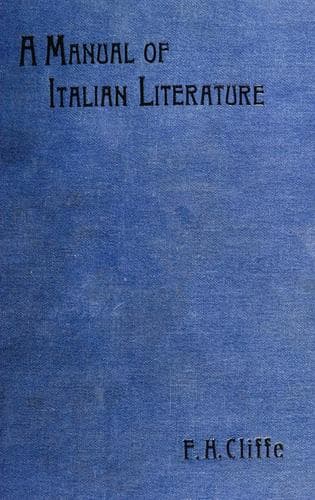
A manual of Italian literatureCliffe, Francis Henry
History
A manual of Italian literature
Cliffe, Francis Henry
Italian literature -- History and criticism
Leopardi abandoned the idea of flight and resigned himself as best he
could to the melancholy life he was compelled to lead. His home was
dull, but it was not, it could not have been, the Hell upon earth that
Montefredini, one of his biographers, would have us believe. There was
no domestic discord; not a trace of strife is discernible. The style
of living in Monaldo's house was handsome and even luxurious, but
neither his father nor his mother seem to have encouraged visitors or
to have entertained as might be expected from their rank. Of Leopardi's
acquaintance with Pietro Giordani they were undoubtedly apprehensive.
Giordani, although a Priest, had the reputation of being a freethinker
at heart, and they trembled lest he should infect the poet with his
opinions. It is even suspected that many letters between the friends
were intercepted. But others not only reached their destination, but
have been preserved and published, and they now form a noble memorial
of confidence and friendship. Leopardi was able at intervals to devote
himself to his favourite pursuit of literature and he published some
of his earlier poems; but their patriotic character frightened the
apprehensive Monaldo. He was afraid his son would be regarded as a
sympathiser with the Carbonari, and Leopardi had to distribute the
copies surreptitiously and to speak of them as little as possible.
He was abandoning his labours in the field of Classical Antiquity and
turning his attention to original and stirring themes, full of life and
actuality. But, unhappily, the more his intellect expanded, the more
his health deteriorated. The blackest melancholy never left him, and it
became daily intensified by his persistent habits of introspection. He
complains in a letter to Giordani of utter weakness of his whole body
and especially of the nerves. We hear nothing of doctors being called
in to arrest the evil, nor does the patient himself seem to have asked
for them. Things were allowed to drift until it was too late. "I am
lying," he says in one of his letters to Giordani, "under a mountain of
sorrows, and not a ray of hope can be seen." "I speak from my heart
and I do not pretend," he exclaims. The great poet is already a great
pessimist.
In 1821 the tone of his letters became a trifle more cheerful and he
was interested in the engagement of his sister Paolina, and he wrote
a poem on her marriage. But the negotiations were broken off and the
wedding never took place.
Public-domain text, read in full here on John Shaqi.
Reviews
Reviews
No reviews yet
Be the first to share your thoughts on this work.
Elsewhere in the archive
Join the Discussion
Join the discussion
Sign in to leave a comment or review.
Sign InorCreate an account