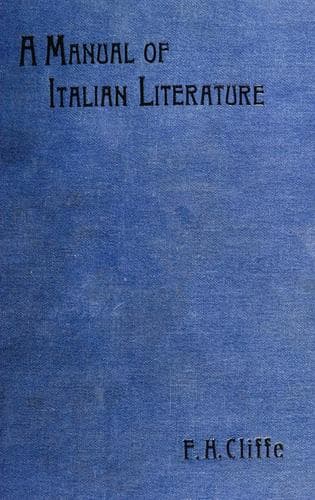
A manual of Italian literatureCliffe, Francis Henry
History
A manual of Italian literature
Cliffe, Francis Henry
Italian literature -- History and criticism
Conscious of the immense reputation he already possessed of vast
erudition, his parents formed the hope that he would embrace the
ecclesiastical career and rise to high dignities in the Roman Curia.
When at last their consent was obtained for his departure from home
in the hope that change would benefit his shattered nerves, it was to
Rome that he was sent, doubtless with the desire that he should make
acquaintances useful to him in the future. He resided with his maternal
uncle, the Marquis Carlo Antici. But no sooner had he arrived in Rome
than he regretted Recanati, and it became apparent that wherever he
went, one of his most striking oddities was an intense horror of his
place of residence, an utter loathing which he neither moderated
nor concealed. If he called Recanati a dungeon, he called Rome a
gigantic sepulchre. His shattered nerves could ill bear the concourse
of people around him, and he saw in society, not its vivacity and
animation, but its frivolity and emptiness. For the literary men of
Rome he entertained immeasurable contempt. He despised them for their
devotion to Antiquarian minutiæ. But this reproach came with ill-grace
from Leopardi, who had himself devoted years of laborious study, who
had even squandered the precious possession of health in laborious
elucidation of grammatical and philological problems, hardly more
important than the coins and inscriptions of Roman Antiquarians.
He made, however, some agreeable acquaintances, pre-eminent among whom
was the historian Niebuhr, at that time Prussian Ambassador to the
Vatican. Niebuhr conceived the most intense admiration for his genius
and spoke of him in the highest terms to Cardinal Consalvi, Secretary
of State to Pius VII. The Cardinal offered him the prospect of
valuable preferment, but only on condition that he should embrace the
ecclesiastical career. To this, however, Leopardi offered invincible
repugnance. Neither his own interests nor the persuasion of friends
could induce him to yield. Pius VII died in 1823, and Consalvi retired
from the direction of public affairs. So favourable an opportunity
never returned. Niebuhr offered Leopardi an appointment in Prussia,
but he refused, dreading the long journey and the severe climate of
Berlin. Great as his reputation was, no other opening offered itself.
It is curious to reflect on the vicissitudes of literary fame. Leopardi
is now valued for his lyric poems and for his dialogues and thoughts
in prose; but his laborious studies in philology, studies to which he
sacrificed health and happiness, are rapidly sinking into oblivion.
When he first went to Rome, he had hardly written a line of that
which has conferred immortality upon him. All the esteem he enjoyed
was lavished upon him for the fruits of his juvenile industry. The
grammarian who could solve the most difficult passages in the ancient
writers of Greece and Rome, who was as well versed in the Talmud as in
Public-domain text, read in full here on John Shaqi.
Reviews
Reviews
No reviews yet
Be the first to share your thoughts on this work.
Elsewhere in the archive
Join the Discussion
Join the discussion
Sign in to leave a comment or review.
Sign InorCreate an account