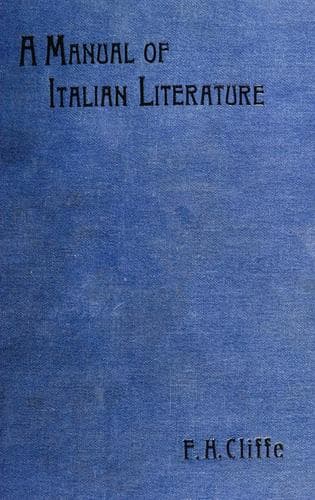
A manual of Italian literatureCliffe, Francis Henry
History
A manual of Italian literature
Cliffe, Francis Henry
Italian literature -- History and criticism
These extracts will enable the reader to form an idea of the power
of thought and depth of feeling that characterise Leopardi's Poems,
although the beauty of his diction may not be reproduced in all its
purity and sweetness. Never was there a poet who knew how to handle
the Italian language with greater skill, or to give it more enchanting
melody or more varied cadences. If he has a fault, it is that he is
sometimes too indifferent to ornament, and that his simplicity now
and then degenerates into poverty and bareness. But when we remember
what Italian poetry had become in his time, how artificial, how
overladen with meretricious ornaments, we shall think him worthy of
praise, rather than deserving of censure. His earlier poems are the
most ornate, and it was only by degrees that he attained that crystal
clearness of style for which we find no parallel in the Italian
language. His frequent use of a capricious succession of rhymed and
unrhymed lines allows him to develop his thoughts with perfect freedom;
indeed, so easy is the metre, that were it not for his happy selection
of words and exquisite variety of cadence, it would border dangerously
on the slipshod; indeed, it does so in the works of his imitators, and
of recent years it has been, probably for that reason, abandoned by
poets in favour of systems more rigid and perhaps more epigrammatic.
Leopardi had every characteristic of a great lyric poet. If his
pessimism is sometimes too pronounced for many readers, it must be
admitted that the evils of life are sufficiently numerous to justify
his elegies; and he atones for any excess of gloom by the most
exquisite pictures of nature and of love. The world appears more
beautiful, though more terribly and darkly beautiful, in his poems than
in reality. He has a rare power of musical diction which delights the
ear even in his most melancholy passages. Indeed, the secret of his
power lies in the unique and exquisite contrast between the gloom and
bitterness of his thoughts and the sweetness and radiant beauty of his
style.
He has also the rare power of concentrating in a few lines a whole
world of thought and emotion. Thus, in the _Risorgimento_:
"Meco ritorna a vivere
La piaggia, il bosco, il monte;
Parla al mio core il fonte,
Meco favella il mar.
In the poem _To Sylvia_ quoted above, he calls her "his hope so much
bewailed," "mia lacrimata speme." In the _Ricordanze_ he calls Nerina
"his eternal sigh." Numerous other instances could be adduced. Take,
for example, the lovely passage in the _Canto Notturno,_ where the
shepherd apostrophizes the Moon:
"Pur tu, solinga, eterna peregrina,
Che si pensosa sei, tu forse intendi,
Questo viver terreno,
Il patir nostro, il sospirar, che sia;
Che sia questo morir, questo supremo
Scolorar del sembiante,
E perir della terra, e venir meno
Ad ogni usata, amante compagnia."
Public-domain text, read in full here on John Shaqi.
Reviews
Reviews
No reviews yet
Be the first to share your thoughts on this work.
Elsewhere in the archive
Join the Discussion
Join the discussion
Sign in to leave a comment or review.
Sign InorCreate an account