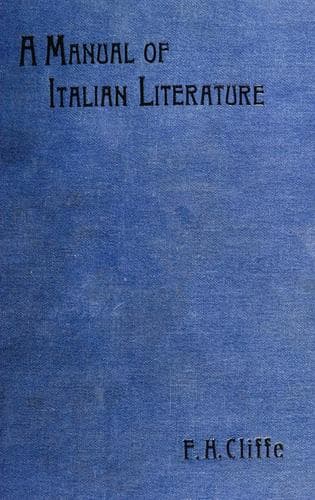
A manual of Italian literatureCliffe, Francis Henry
History
A manual of Italian literature
Cliffe, Francis Henry
Italian literature -- History and criticism
His pathos and tenderness, expressed in language of the most perfect
purity and sweetness, and adorned with the rainbow hues of his vivid
imagination, produce an effect more poetical than words can describe.
I know of no lyric poet who keeps the mind of his reader under a more
potent spell. Others, like Horace and Alfred de Musset, may be more
entertaining, others, again, like Keats and Shelley, may delight us
with airier and more brilliant flights of fancy, but Leopardi leads us
to the brink of abysses and shows us their unfathomable depth.
He always writes from his heart, a rare quality, for we may find
twenty poets who write from the head for one who writes from the
heart. He never attempts a task for which he is unfitted. His powers
of reasoning in verse are very great, but his argument never becomes
unpoetical, never becomes dryly didactic. If his works have a fault,
it is that now and then the poems have a tendency to fall off towards
the end, and in his later works there is a certain languor of style,
probably the result of ill-health. He is a great master of blank verse,
and only in one of the poems in that metre, the _Palinodia,_ does he
become heavy and prolix. Sometimes, when he is not sustained by any
great thought, his extreme simplicity degenerates into poverty. Very
few poets could venture to be as simple as Leopardi.
His works have the effect of growing upon the reader. The second
perusal pleases better than the first, and the more they are read, the
more they are admired. In quantity of verse produced, he is surpassed
by many writers; but in quality, by none.
His prose works, like his poems, are few in number and short in
dimension. They comprise dialogues (a form of which he was very fond),
a few essays, and over one hundred detached fragmentary thoughts. They
make only a small volume of most unimposing bulk, but the beauties of
thought and style are so great that many critics have extolled them
as the most perfect production of Italian prose. They all set forth
his pessimism and his melancholy, but with so much art and variety,
that while they convince us of the world's misery, they also enchant
us with its beauty. Leopardi made a profound study of the great prose
writers of the Fourteenth Century, and he alone succeeds in reproducing
to perfection the freshness and harmony of their style. Some passages
are so magnificent that they cry out aloud to be put into verse. In his
prose we find less of his heart (that wonderful heart that embraced the
whole world in its sympathy) and more of the vivacity of his fancy than
in his verse.
Public-domain text, read in full here on John Shaqi.
Reviews
Reviews
No reviews yet
Be the first to share your thoughts on this work.
Elsewhere in the archive
Join the Discussion
Join the discussion
Sign in to leave a comment or review.
Sign InorCreate an account