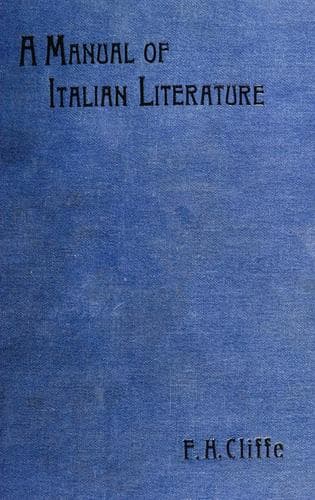
A manual of Italian literatureCliffe, Francis Henry
History
A manual of Italian literature
Cliffe, Francis Henry
Italian literature -- History and criticism
In 1822 he published his tragedy _Adelchi._ As _Carmagnola_ gave a
picture of the Oligarchy of Venice, so does _Adelchi_ give us a picture
of the rule of the Lombard Kings. It is written with as much care as
its predecessor, and with more fire ind energy. But even here he is far
indeed from displaying Alfieri's mastery over blank verse. Appended to
this tragedy we find a long and valuable essay on the Lombards in Italy.
Manzoni contemplated a third tragedy. It was to have been on the
subject of Spartacus, but not more was written than an introductory
Chorus.
These works procured a high reputation for the poet, a reputation
which became even European when he published in 1826 his celebrated
historical romance, _I Promessi Sposi--The Betrothed._ No prose work
in the Italian language has been received with greater enthusiasm in
foreign countries than this. Translations appeared in every European
language; edition after edition was called for, both of the original
and of the renderings. The daily papers teemed with laudatory notices;
the author was overwhelmed with tokens of esteem and admiration, and
his countrymen hailed in him with rapture an Italian Scott.
His reputation reached its zenith in 1830. But if his admirers expected
that he would display the fertility of his Caledonian prototype, they
were doomed to disappointment. He was renowned as the writer of two
able tragedies, of one of the most brilliant lyrics in any language,
and of the most successful novel that Italy had ever produced. He
was rich and comfortable, two strong incentives to indolence. He had
acquired fame so great that it would be impossible to add to it; what
need was there for him to labour and toil in producing works that
could not by any possibility approach the marvellous success of their
predecessors? Accordingly, we find that Manzoni wrote but little after
the appearance of the _Promessi Sposi,_ and that little is not of great
importance. In his _Storia della Colonna Infame,_ he protests, like a
true descendant of Beccaria, against the horrors of the rack; in his
_Morale Cottolica,_ he displays considerable powers of observation and
of argument.
He had numerous children, but many of them predeceased him. His eldest
daughter married Massimo d'Azeglio.
After the Italian victories of 1859, he was elected a member of the
Senate assembled at Turin, but he only attended its debates on two
occasions, probably owing to advancing age. He was offered high
dignities and the medals of many Orders; but he refused them all, and
lived in simple retirement, sufficiently distinguished by his renown,
and by the esteem accorded to his amiable and benevolent character. He
died on the 22nd of May, 1873, and Milan accompanied her poet to the
grave with magnificent obsequies.
Public-domain text, read in full here on John Shaqi.
Reviews
Reviews
No reviews yet
Be the first to share your thoughts on this work.
Elsewhere in the archive
Join the Discussion
Join the discussion
Sign in to leave a comment or review.
Sign InorCreate an account