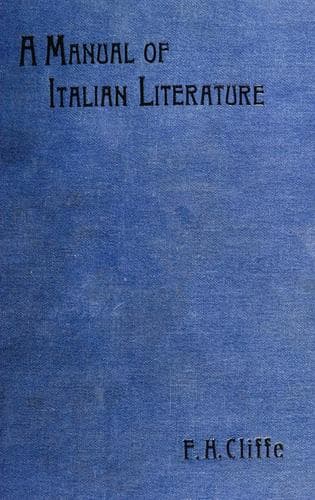
A manual of Italian literatureCliffe, Francis Henry
History
A manual of Italian literature
Cliffe, Francis Henry
Italian literature -- History and criticism
Turning from the man to his works, we find both his prose and his
poetry characterized by a noble spirit of repose. There is nothing
stormy or angry in his writings, for there was nothing to disturb or
to embitter his mind. He resemble Goethe in the cloudless serenity of
his intellect, though he may not equal him in the rarer attributes
of genius. It was probably this very repose that militated against
his success as a dramatist, for if they did not present so faithful a
picture of an historical epoch, his two tragedies would hardly deserve
the attention they received.
This happy peace of mind enabled him to reproduce very clearly what he
observed and imagined. It is, therefore, no cause for wonder that when
he devoted the powers of his mind to the production of an historical
novel, he should have given a masterpiece to the world. The story is
interesting. We follow the vicissitudes of the lovers with breathless
attention. The subject is well fitted to the author's powers. He
writes of localities among which he lived, and of times, the history
of which he had profoundly studied. The descriptions never fail to be
vivid and accurate, and the skill with which he masses together great
events cannot be too highly extolled. Nothing could be finer than the
description of the plague of Milan, and of the popular disturbances.
Nor is he less admirable in the delineation of character. The portrait
of the Friar would be alone sufficient to show his mastery in that
line. The style has its beauties, but even in this most successful
work of the Nineteenth Century we notice the same peculiarities as in
his dramas; the characters say what they ought to say, but they do not
always say it in a striking manner. Little as he resembled Leopardi,
he was like him in a certain indifference to ornament which sometimes
degenerates into poverty.
In reading Manzoni's works we become aware how much the romantic
movement benefited literature. A new life is infused into prose and
poetry; fresh thoughts arise in the writer's mind, and the wretched
conventionalities of phraseology are done away with for ever.
Above praise though the _Promessi Sposi_ may be, it is not possible
to extol Manzoni very highly as a poet. With the exception of the
magnificent _Cinque Maggio,_ his lyrics do not glow with vivid
fire, nor do they haunt the reader with their melody. The extremely
comfortable circumstances of the poet's life prevented him from being
torn with passion and harrowed by despair. His genius had nothing wild
or impetuous about it to spur him on to a passionate outpour of song.
Nor had he the gaiety of convivial, or the acrimony of satirical,
verse. Therefore, it is not strange that he has left us nothing quite
worthy of his renown in the lyric line, always excepting the poem on
the death of Napoleon.
Public-domain text, read in full here on John Shaqi.
Reviews
Reviews
No reviews yet
Be the first to share your thoughts on this work.
Elsewhere in the archive
Join the Discussion
Join the discussion
Sign in to leave a comment or review.
Sign InorCreate an account