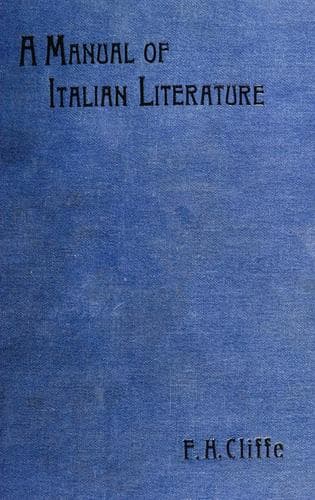
A manual of Italian literatureCliffe, Francis Henry
History
A manual of Italian literature
Cliffe, Francis Henry
Italian literature -- History and criticism
His powers of versification are not very remarkable. He is deficient
in the delicate cadences of a truly great poet. His blank verse has
a tendency to become flat. His rhymes are stronger, but the metre,
though effective, is not modulated and varied with the consummate
skill that can alone satisfy a cultivated ear. But all his poems are
the emanation of a truly noble mind, and if we search the pages of
Manzoni, whether in his prose or in his verse, for lofty thoughts and
elevating influence, we can truly say that we never search in vain.
CHAPTER XXI.
SILVIO PELLICO.
A work hardly inferior in popularity to the _Promessi Sposi_ was _Le
Mie Prigioni,_ an account of all that he suffered in Austrian prisons,
by SILVIO PELLICO.
The author of this celebrated book was born at Saluzzo, in Piedmont, in
1788. He spent his youth in France, but shortly after he came of age,
he returned to Italy and settled in Milan. He supported himself for a
while as a tutor, and then as a journalist. He wrote several tragedies,
the best of which is _Francesca da Rimini,_ and a spirited translation
of Byron's _Manfred._
In conjunction with a few friends, he published a paper, _Il
Conciliatore._ Some articles excited the displeasure of the Austrian
Government, and the paper was forbidden to appear. The disturbances
in Piedmont in 1820 aroused the fears of the Authorities, and he was
arrested with some of his companions and taken to Venice, where he was
first of all confined in the "Piombi" in the Doge's Palace, and then in
the prison on the Island of San Michele. He and his confederates were
sentenced to death, but the capital sentence was commuted to fifteen
years imprisonment in a fortress for Pellico and twenty years for his
friend Maroncelli. Both victims were removed in 1822 to the Spielberg,
near Brunn, in Moravia, and confined in subterranean dungeons. They
were treated with the utmost rigour. Heavy manacles were fastened
to their limbs; coarse and scanty fare alone was provided for them.
Pellico's health was never strong, and it broke down utterly under such
rigorous treatment. He fell dangerously ill, and a certain relaxation
was made in order to save his life. But no sooner was he on the way to
recovery, than the former severities were revived and even aggravated.
He was no longer allowed to beguile his wretched captivity with reading
and writing, and all that he could do was to brood in his wretched
dungeon over his sorrows and to wonder whether he would live until the
day appointed for his release. His wounded spirit took refuge in the
consolations of a somewhat mystic piety. In later years the demand for
a United Italy brought the patriots into collision with the Papacy,
whose adherence to the claim of temporal power for the Pope was
inflexibly maintained, and the collision resulted in bitter hostility
to Christianity; but for at least the first forty years of the
Century nearly every patriot was a fervent Catholic, whose religious
Public-domain text, read in full here on John Shaqi.
Reviews
Reviews
No reviews yet
Be the first to share your thoughts on this work.
Elsewhere in the archive
Join the Discussion
Join the discussion
Sign in to leave a comment or review.
Sign InorCreate an account