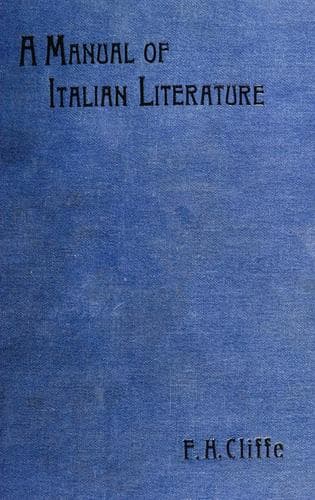
A manual of Italian literatureCliffe, Francis Henry
History
A manual of Italian literature
Cliffe, Francis Henry
Italian literature -- History and criticism
Far and away the most important of his works is _Le Mie Prigioni,_
the record of his weary years of cruel captivity. The book was a
prodigious success, and was read wherever freedom was loved and
tyranny detested. No literary production of the age was more welcome
to Italian patriots, because it furnished them with so forcible a
justification for rising against their oppressors. Indeed, the marvel
is that a nation like the Italian bore the yoke of foreign invaders
so long. Italy was not like Poland, without natural frontiers to act
as a barrier against the aggression of powerful neighbours. Nor was
she, like Poland, distracted by internal faction and discord. Why,
therefore, did she submit so long? The only answer, in my opinion, is
that the system in the Middle Ages of hiring venal condottieri and
their followers to fight their battles demoralised the Italians until
they failed to realise their own inherent strength. When once the
nation resolved to be free, the task was not so stupendously difficult.
It was a fortunate circumstance for Italy that neither Spain nor
Austria ever attempted to effect settlements of their own subjects
on her soil, as England did in Ireland and as Russia is now doing in
Poland. Thus, when the hour of freedom struck, the Italians had only to
overcome hostile garrisons, they had not to uproot a settled population.
The style of Silvio Pellico is eminently clear and direct, and his work
is on that account a great favourite with foreigners beginning the
study of the language. He has considerable powers of description, and
he succeeds admirably in reproducing the colouring and the atmosphere
of the scenes he went through. He is occasionally too sentimental,
and the tears he sheds are out of all proportion to the fortitude he
displays. But a great wave of sentimentality was passing over Italy at
that time, and it was perhaps wanted to bring men back to nature after
the artificiality of the past.
His gaolers seem to have been as kind to him as they dared; but the
rules of the prison were terribly rigorous, and they were not relaxed
for Silvio and his confederates, blameless though their characters were
known to be. Maroncelli had to submit to the amputation of a leg owing
to the mortification resulting from the friction of his heavy fetters,
and Pellico himself was prostrated by illness from his excessive
hardships, so that for a while his life was in danger, and great
indeed would have been the loss to Literature had a fatal termination
prevented him from leaving to posterity the record of a cruel captivity
and of a lofty and unsullied patriotism.
CHAPTER XXII.
POETS OF THE NINETEENTH CENTURY.
Public-domain text, read in full here on John Shaqi.
Reviews
Reviews
No reviews yet
Be the first to share your thoughts on this work.
Elsewhere in the archive
Join the Discussion
Join the discussion
Sign in to leave a comment or review.
Sign InorCreate an account