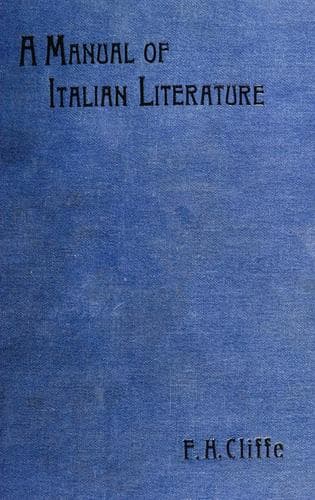
A manual of Italian literatureCliffe, Francis Henry
History
A manual of Italian literature
Cliffe, Francis Henry
Italian literature -- History and criticism
The most conspicuous, though not in reality the most eminent, of the
Italian poets in the early part of the Nineteenth Century, was VINCENZO
MONTI. The inexhaustible fluency of his verses attracted universal
attention, and even Leopardi worshipped at his shrine. But he was
only an idol, not a divinity. The feet of clay soon became apparent.
He veered round with shameless apostacy from one political party to
another. Beginning his career by flattering Pius VI, he continued it by
extolling the French invaders, and concluded it by grovelling before
the Austrian tyrants. He wrote odes without enthusiasm, and tragedies
without dignity, and he translated Homer without knowing sufficient
Greek to read the original. An epigram was suggested for his portrait:
"Questo è Monti, poeta e cavaliero,
Gran traduttor dei traduttor d'Omero."
But it would be unjust to deny that he had great flexibility of style
and full command over all the resources of the language. He is always
elegant and flowing, and his works, such as they are, never sin against
the canons of good taste. Perhaps the most pleasing of his shorter
poems is a very beautiful sonnet on the portrait of his daughter.
A far more masterful and daring spirit was UGO FOSCOLO. His poem _I
Sepolcri_ attracted universal attention, but it can hardly be said
that the promise of this poem was fulfilled by later works. He had
brilliant gifts, but he was inclined to fritter them away on learned
trifles. As a prose writer he exercised a wider influence. His _Lettere
di Jacopo Ortis,_ were to Italy much what Goethe's _Werther_ was to
Germany. He was an admirable critic, and his essays on Dante, Petrarch
and Boccaccio are valuable even at the present day. He took refuge in
England, and some of his best articles were written in English, being
subsequently translated into his mother-tongue. He died at Turnham
Green, near London, in 1827.
MELCHIORRE CESAROTTI translated Macpherson's _Ossian,_ and was a
powerful promoter of the romantic movement.
IPPOLITO PINDEMONTE wrote many poems distinguished by a gentle
pensiveness, and he translated the _Odyssey_ with considerable success.
GIOVANNI BERCHET of Milan, contributed largely by his verses to kindle
the fire of patriotism, but vigorous and stirring though they be, they
have hardly sufficient finish and delicacy to rank as works of art.
GIUSEPPE GIUSTI was a satirist of amazing raciness and originality. He
attacked the tyrannical Governments of his day, and he knew neither
fear nor discretion. Those who can form an idea of what Mr. Gilbert's
inexhaustible powers of grotesque versification would produce if
directed towards political satire, may conceive what Giusti's poems
are. He died of consumption in 1850.
FELICE BELLOTTI, of Milan, rendered noble services to the literature of
his country by his magnificent translation of the _Lusiad_ of Camoens,
the _Argonautica_ of Apollonius Rhodius, and the tragedies of Æschylus,
Sophocles and Euripides.
Public-domain text, read in full here on John Shaqi.
Reviews
Reviews
No reviews yet
Be the first to share your thoughts on this work.
Elsewhere in the archive
Join the Discussion
Join the discussion
Sign in to leave a comment or review.
Sign InorCreate an account