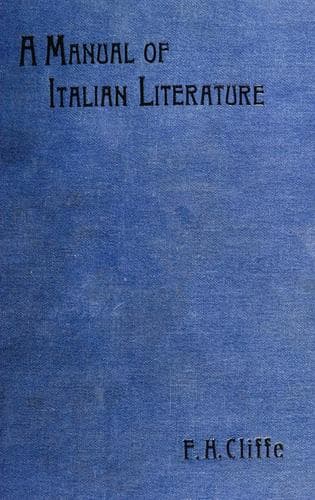
A manual of Italian literatureCliffe, Francis Henry
History
A manual of Italian literature
Cliffe, Francis Henry
Italian literature -- History and criticism
Petrarch was fortunate in acquiring the friendship and favour of some
of the most eminent men of his time. Jacopo Colonna, Bishop of Lombés,
invited him to his palace at the foot of the Pyrenees. He gratified
his intense desire to see the world by travelling through France and
Germany, and subsequently visiting many cities of Italy. In Rome he
was welcomed by Stefano Colonna, the head of that illustrious family,
but Rome was then deserted and lonely, and Petrarch soon returned to
the more brilliant circles of Avignon. He found a delicious retreat
fifteen miles from Avignon, at Vaucluse, a pleasant valley, watered by
the river Sorga. Here he produced some of his loveliest Italian poems,
and some of his most elaborate Latin compositions. So uncertain are
the vicissitudes of literary taste, and so little do even great poets
know where their real strength lies, that Petrarch treated his sonnets
and canzoni, to which alone he is indebted for his immortality, as the
amusement of his leisure hours, and devoted all his care and study to
those Latin works which are now read only by the curious. He composed
a ponderous epic poem in Latin hexameters, and gave it to the world
under the title of _Africa._ It procured for him an immense reputation.
The whole literary world read it with avidity, and all Europe resounded
with his praises. Paris and Rome simultaneously invited him to be
crowned with the laurel within their walls. He decided to accept the
invitation of Rome; but before the ceremony he went to Naples, where
he was received with enthusiasm by King Robert, who was so enraptured
with the _Africa_ that he begged it should be dedicated to himself.
This request the poet gladly granted, and he left for Rome laden with
signs of Royal favour. He was crowned in the Capitol by the Senator
Orso dell' Anguillara, on the 8th of April, 1341, and the laurel wreath
bestowed upon him he hung up as a votive offering in the Church of St.
Peter.
Petrarch was one of those who succeed in everything; and, as if the
distinctions already showered upon him were not enough, he was, when
visiting Parma, invited to the Court by Azzo da Correggio, and within a
short time sent as his envoy to Clement VI at Avignon. He wrote a Latin
poem advising the Pope to return to Rome, and his Holiness, though
he did not take the advice, was so delighted with the poem that he
bestowed a valuable benefice on its author.
Public-domain text, read in full here on John Shaqi.
Reviews
Reviews
No reviews yet
Be the first to share your thoughts on this work.
Join the Discussion
Join the discussion
Sign in to leave a comment or review.
Sign InorCreate an account