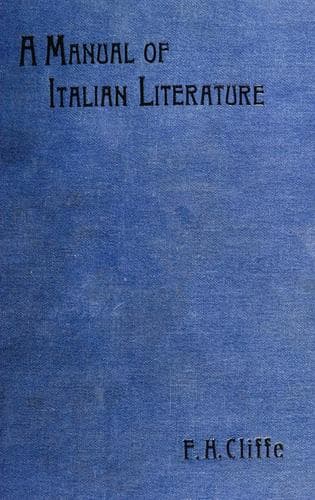
A manual of Italian literatureCliffe, Francis Henry
History
A manual of Italian literature
Cliffe, Francis Henry
Italian literature -- History and criticism
GIAMBATTISTA NICOLINI was the author of numerous tragedies, but his
tendencies were as much political as poetical, and his poetry suffers
in consequence.
JACOPO VITTORELLI was musical and flowing in his verse, and some of his
best lines are worthy of the pen of Metastasio.
The poems of GIUSEPPE PUZZONE have a tender sentimentality that is both
moving and pleasing,
GIUSEPPE BORGHI translated Pindar, and wrote poems of his own with
considerable fire and originality.
LUIGI CARRER, a Venetian, had the merit of opening up new sources of
ideas in his poems, and he has much pathos and command of language.
GABRIELE ROSSETTI, the father of a celebrated family, was inspired by
patriotism in almost everything he wrote. Some of his patriotic hymns
have inimitable fire and energy. He took refuge in England, where he
died in 1854.
The poems of ALEARDO ALEARDI are remarkable for strength of
imagination, but his powers of execution are not considerable.
GIOSUE CARDUCCI ranks very high among the poets of the Nineteenth
Century, but his endeavours to revive the mythology of which the world
had become utterly weary were not very judicious, although in his case
they were redeemed by great learning and much force of imagination. He
tried to introduce the metres of Horace into Italian, but the result is
not very musical.
ENRICO PANZACCHI is a true poet, and his imagery is always graceful and
in good taste.
The same cannot be said of OLINDO GUERRINI who, under the pseudonym of
LORENZO STECHETTI, published poems remarkable for freshness and melody
of style, but also, unhappily, for coarseness and indecency. He is very
successful in the art of making the verses sing; they really come from
the heart of the poet and go straight to the heart of the reader.
The Sicilian RAPISARDI produced some fine works, among others a long
poem on the afflictions of Job. It is full of imagination, but it would
be difficult to conceive a more unnecessary work; the book of Job is so
sublime in itself that any reproduction, not a literal translation, is
either a dilution or a "gilding of refinéd gold."
GIOVANNI PRATI had great powers of thought and genuine inspiration. His
_Armando_ is a very noble work, but it is somewhat wanting in skilful
construction, and in everything he wrote his beauties are rather heaped
together than skilfully displayed.
PIETRO COSSA produced some tragedies very unlike those of Alfieri,
full of crude colours and startling contrasts, by which he obtained an
immense vogue, but it is doubtful whether they will stand the test of
time.
ADA NEGRI, of Milan, has published some lyrics full of the most
extraordinary fire and brilliancy, and if she continues as she has
begun, she cannot fail to produce something great.
The ABBE ZANELLA has published poems which have been much admired. He
is reported to be the favourite poet of Leo XIII.
Public-domain text, read in full here on John Shaqi.
Reviews
Reviews
No reviews yet
Be the first to share your thoughts on this work.
Elsewhere in the archive
Join the Discussion
Join the discussion
Sign in to leave a comment or review.
Sign InorCreate an account