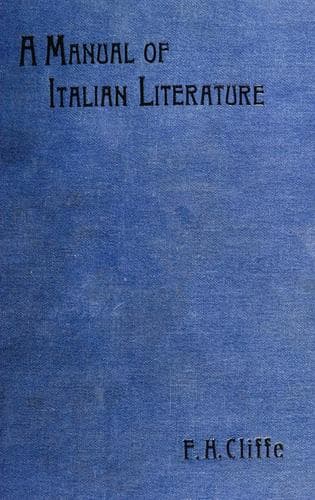
A manual of Italian literatureCliffe, Francis Henry
History
A manual of Italian literature
Cliffe, Francis Henry
Italian literature -- History and criticism
JACOPO PASSAVANTI, a Dominican. Friar, wrote a devotional book,
entitled, _Lo Specchio della Penitenza,_ written in prose so musical
and flowing as to be preferred by some to the prose of Boccaccio,
because Passavanti never indulges in the over-elaboration sometimes to
be detected in the pages of the _Decamerone._
GIOVANNI DA CATIGNANO known in the Calendar as the Blessed John of the
Cells, after a dissolute youth was converted by the ardent exhortations
of the Abbot of Vallombrosa, and in deep contrition ended his days as a
hermit. Some letters from this interesting penitent are extant, written
in a style so exquisitely Tuscan that they are quoted by the Accademia
della Crusca as models of propriety and elegance.
Another canonized celebrity, SAINT CATHERINE OF SIENA, is no less
remarkable for the beauty of her style than for the beauty of her
character.
A Life of Saint Francis of Assisi, entitled _Fioretti di San
Francesco,_ has been highly praised for the freshness and simplicity
of the language. The piety or the modesty of the author induced him to
conceal his identity.
These religious writers, though treating of subjects so different,
almost equalled Boccaccio in perfection of style, but the two authors
who produced collections of stories somewhat similar to his, FRANCO
SACCHETTI and SER GIOVANNI FIORENTINO, were very far indeed from
approaching his mastery.
On reviewing the literary development of Italy in the Fourteenth
Century, we find that the language attained the fullest perfection
both in prose and verse, only the lighter kinds of poetry remaining
uncultivated. The appearance in one century of two such great poets as
Dante and Petrarch was quite phenomenal and threw a lustre over the age
which has attracted the whole world. But another fact, less universally
known, is equally worthy of attention, namely the extraordinary merit
of the prose writers of the period. It may well be doubted whether
any compositions in Italian prose of a later date exhibit the rare
qualities of those of the Fourteenth Century. Leopardi, indeed,
produced marvels of style, but they were the result of art and study,
whereas the writers of the Fourteenth Century display an ease and a
simplicity, a freshness and a graphic power, combined with the most
exquisite lightness and harmony in their phrases, that must ever
render them more admirable models than the artificial and laborious
productions of later ages.
[Footnote 1: For details on the subject of this most terrible
pestilence, probably the worst that ever afflicted humanity, we may
refer the reader to Father Gasquet's valuable and interesting work on
the subject.]
CHAPTER V.
WRITERS OF THE FIFTEENTH CENTURY.
Public-domain text, read in full here on John Shaqi.
Reviews
Reviews
No reviews yet
Be the first to share your thoughts on this work.
Join the Discussion
Join the discussion
Sign in to leave a comment or review.
Sign InorCreate an account