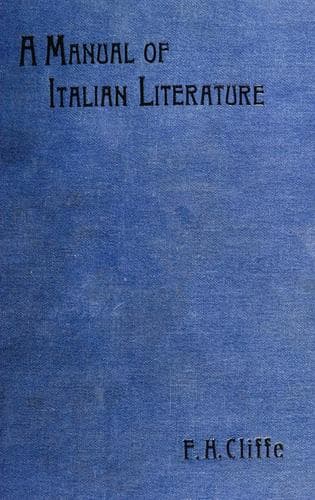
A manual of Italian literatureCliffe, Francis Henry
History
A manual of Italian literature
Cliffe, Francis Henry
Italian literature -- History and criticism
Machiavelli is as undoubtedly the first prose writer of the age as
Ariosto is the first poet, Second to him as an historian, though at a
wide interval, we may place his friend and fellow-townsman, FRANCESCO
GUICCIARDINI, born in 1480, died in 1540. He studied law to such good
purpose at Florence, Ferrara and Padua, that at the early age of
twenty-two he was chosen to lecture on the Institutes of Justinian,
and at the age of thirty-one he was sent as Ambassador to Ferdinand of
Aragon, which post he occupied for two years. With the help of that
King, Julius the Second forced the Florentines to submit again to the
rule of the Medici family. Guicciardini was suspected by the friends
of liberty of having a hand in the negotiations between the Pope and
the King, and of being a tool of that ambitious dynasty. Such, in
truth, he proved himself; and harshness, rancour, and vindictiveness
characterised his conduct towards his political opponents. When Leo
X visited Florence in 1515, Guicciardini was sent by the Republic
to receive him at Cortona. No circumstance could have proved more
favourable to the historian's career. Leo X looked upon him with
the utmost favour, and nominated him to high and important offices,
which his successor, Adrian VI, continued, and to which Clement VII
subsequently added others. When the "Holy League," headed by the Duke
of Urbino, was formed against the Emperor Charles V, Guicciardini was
one of its leading spirits. But the Imperial arms prevailed; Clement
VII had to take refuge in the Castle of St. Angelo, and had the agony
of seeing Rome stormed and plundered under his very eyes. Atrocious
were the cruelties committed. St. Peter's itself was stained with
the blood of the slaughtered. Huge contributions were levied on the
citizens, and an enormous ransom exacted from the Pope. Seeing Clement,
himself a Medici, deprived of liberty and even in danger of his life,
the Florentines took to arms and expelled the obnoxious dynasty. But
the unexpected happened. The injured Pope and the tyrannical Emperor
became reconciled; and probably to atone for the atrocities committed
by his forces, Charles V lent effective aid to Alexander de Medici in
his endeavour to regain his lost dominion over Florence. Guicciardini
became the instrument of Alexander, a cruel and relentless tyrant, who
was subsequently assassinated by his kinsman Lorenzino. Guicciardini
was an active agent in the election of Cosimo I, and when he was
reproached for imposing another tyrant on his country, he answered that
the more princes were assassinated, the more would arise. But Cosimo
was ungrateful when Guicciardini demanded the reward of his services;
bitter disappointment was in store for him; he withdrew from public
affairs, and lived in retirement at Arcetri, where he died.
Public-domain text, read in full here on John Shaqi.
Reviews
Reviews
No reviews yet
Be the first to share your thoughts on this work.
Join the Discussion
Join the discussion
Sign in to leave a comment or review.
Sign InorCreate an account