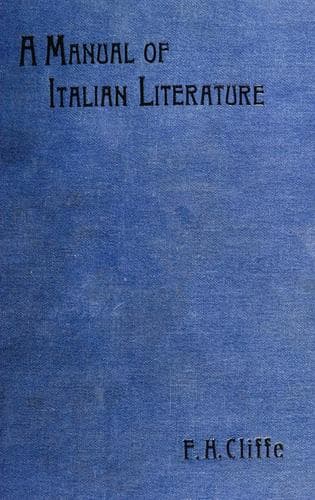
A manual of Italian literatureCliffe, Francis Henry
History
A manual of Italian literature
Cliffe, Francis Henry
Italian literature -- History and criticism
In considering that celebrated poem, the first thought that must
occur to the reader is the extremely happy choice of the subject. It
was unhackneyed; it was picturesque; it was noble. We cannot help
feeling that Ariosto is sometimes dragged down by the frivolous
stories he tells; we cannot help feeling that Tasso is sustained and
inspired by the magnificent episodes it is his duty to narrate. He is
rather too fond of imitating passages from Homer and Virgil, but such
imitation was universal in his day, and in his case it is skilfully
executed. The Oriental colouring of the scenes laid in Palestine and
Syria is, perhaps, not very vivid, but it is quite as vivid as his
contemporaries expected. On the whole it would be harsh to deny that
he has done justice to his subject, and in one respect he deserves the
highest praise: he imparts a human interest and an air of reality to
his characters that cannot be too highly extolled. Ariosto often treats
his characters merely as puppets, and is himself the first to laugh at
them. Very different is the attitude of Tasso towards his creations.
He believes in them with unshaken sincerity, and he loves them because
he believes in them. Erminia, Sophronia, Armida, Rinaldo, Goffredo,
Tancredi, all stand before us in the life, moving and breathing. As
Goethe says, in his play on the subject of Tasso:
"Es sind nicht Schatten die der Wahn erzeugte;
Ich weiss es, sie sind ewig, denn sie sind.
["They are not shadows by illusion made;
I know they live for ever, for they live."]
This great quality undoubtedly explains the universal popularity of the
_Gerusalemme._ That poem even penetrated to classes of the community to
whom, as a rule, literary poets appeal in vain. Detached passages were
set to music, and sung by the people like ballads. For two centuries
the gondoliers beguiled their work with the musical stanzas of the
unhappy poet. Who does not remember Byron's lines?--
"In Venice Tasso's echoes are no more,
And silent rows the songless gondolier."
When they first began to be neglected is not recorded. They seem only
to have been handed down orally. Alterations would inevitably creep in,
and losing their accuracy, they lost also their charm.
Writing in the same stanza as Ariosto, Tasso could not fail to resemble
him in some respects. They are both clear, rapid, and musical. But the
style of the earlier poet is richer, stronger, more original, and,
I think, in spite of an occasional want of tenderness, more truly
poetical. Tasso too often indulges in conventions and common-places,
hence he becomes feeble and unimpressive. To give samples of the two
poets, I will quote a passage from each.
ARIOSTO.
_A ship of the enemy approaches incautiously the fleet of Charlemagne._
Public-domain text, read in full here on John Shaqi.
Reviews
Reviews
No reviews yet
Be the first to share your thoughts on this work.
Join the Discussion
Join the discussion
Sign in to leave a comment or review.
Sign InorCreate an account