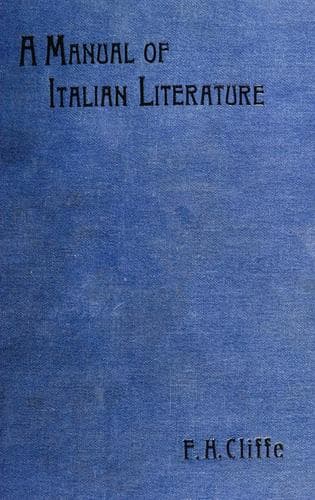
A manual of Italian literatureCliffe, Francis Henry
History
A manual of Italian literature
Cliffe, Francis Henry
Italian literature -- History and criticism
His old friend, Marianna Bulgarelli, died some years after he had gone
to Austria, and she left him a large part of her considerable fortune.
But he refused to accept it, as he was of opinion that it ought to have
gone to her husband, to whom, accordingly, it was handed over.
Metastasio is the only writer of librettos whose works have risen to
the dignity of a classic. Indeed, they are still remembered when the
composers who set them to music have sunk into oblivion. Some of his
dramas seem to have been used by several composers in succession, and
one, _La Clemenza di Tito,_ produced in Vienna for the first time with
the music of Caldara on the fourth of November, 1734, was many years
afterwards used by the illustrious Mozart.
The highest favour of the Imperial family was bestowed upon Metastasio
during the reign of Charles VI, and was continued by the Empress Maria
Theresa and her son, Joseph II. It was only natural that he should feel
the most intense loyalty in return, and when the House of Hapsburg
suffered cruel reverses in the War of the Austrian Succession, and
later on, in the Seven Years' War, he sympathised acutely with his
Imperial mistress.
Alfieri tells us in his _Memoirs_ that he might have had an
introduction to Metastasio during his stay in Vienna, but that he saw
him one day in the park at Schönbrunn making the customary obeisance to
Maria Theresa with an air of such cheerful adulation, that he conceived
the most supreme contempt for so servile a poet. But surely this is
carrying independence to the verge of churlishness. If Metastasio had
not reason to show his gratitude, who had? And the most ardent opponent
of tyranny must own that Maria Theresa had qualities that give her
a lofty rank among the monarchs, not only of her own century, but of
those past and to come.
Metastasio lived in uninterrupted prosperity in Vienna for half a
century, and when he died on the twelfth of April, 1782, he was
universally regretted in the country of his adoption and in that of his
birth. He amassed a handsome fortune of one hundred thousand florins,
which he left to the family of the Councillor Martinez, with whom he
had resided since he first came to Vienna.
Public-domain text, read in full here on John Shaqi.
Reviews
Reviews
No reviews yet
Be the first to share your thoughts on this work.
Elsewhere in the archive
Join the Discussion
Join the discussion
Sign in to leave a comment or review.
Sign InorCreate an account