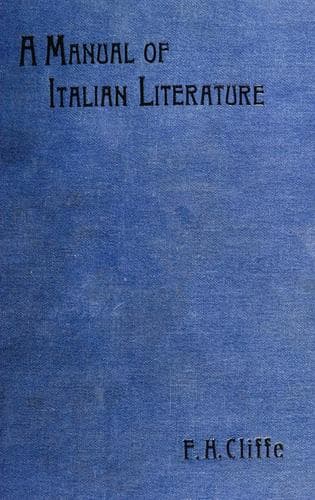
A manual of Italian literatureCliffe, Francis Henry
History
A manual of Italian literature
Cliffe, Francis Henry
Italian literature -- History and criticism
The Eighteenth Century was remarkable for the paucity of eminent Prose
Writers; the Nineteenth Century, on the contrary, can show a brilliant
array of philosophers, historians, and novelists; and it would probably
be more extensive had not the rapid development of journalistic
enterprise drawn many able men to the daily Press, who would in former
ages have devoted themselves to the writing of books. Their articles
in newspapers ind magazines perished after the day of appearance, with
the exception of those rare cases where a writer, or his friends,
made a collection to be published in book form. Thus, many keen and
powerful minds laboured for the enlightenment of their generation,
but no record remains of their productions. The unbounded popularity
of fiction caused greater attention to be bestowed on that branch of
Literature, and memorable works were given to the world. For nearly
seventy years the chief inspirer was patriotism, as was only natural
in the Century that witnessed the liberation of the Peninsula from
foreign oppression. The Literature of England and Germany began to be
studied, and the romantic movement introduced an entirely new style of
subject and treatment. The old conventions of mythological allusions
are at last consigned to merited oblivion, and we find poets expressing
themselves in a direct and natural manner. The former timidity of
philosophical and religious speculation is exchanged for boundless
liberty, often coupled with intense hatred of Christianity. Strong
originality marks the writers of the Nineteenth Century, but that
originality is often purchased at the price of harmonious development
and serenity of mind. They have reason to envy the intellectual
complacency of Ariosto and Metastasio. This discord of the mind is more
marked in Leopardi than in any other writer, although he was almost
the first to display it. In truth, the Nineteenth Century was for
Italy a period of transition. The old forms of thought, as well as the
old forms of government, were gradually overcome and destroyed, and
perhaps it would be premature to say what definite form they are likely
to assume. One thing is certain; the old methods can never be revived,
and the efforts of pedants to infuse new life into their effete
decrepitude can only result in ignominious failure. Self-reliance and
originality must be the watch-words of the future, and it is gratifying
to observe that the best and most promising of the younger generation
of writers are, consciously or unconsciously, opening out new forms
of art and fresh vistas of ideas. That some mistakes have been made,
cannot be denied. Extreme realism has claimed its victims in Italy as
elsewhere. From excessive desire to be exact, some writers have ceased
to be natural. In their endeavour to avoid superstition, other writers
have advocated gross and vulgar materialism. Some have shewn repulsive
want of decency; others, utter disregard for beauty and purity of
style.
Public-domain text, read in full here on John Shaqi.
Reviews
Reviews
No reviews yet
Be the first to share your thoughts on this work.
Elsewhere in the archive
Join the Discussion
Join the discussion
Sign in to leave a comment or review.
Sign InorCreate an account