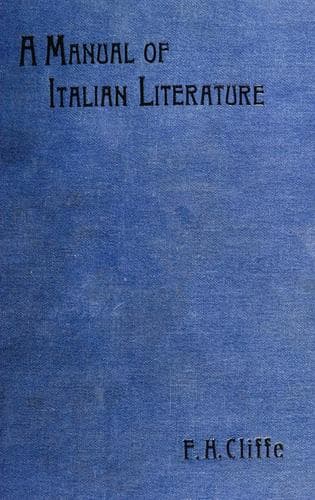
A manual of Italian literatureCliffe, Francis Henry
History
A manual of Italian literature
Cliffe, Francis Henry
Italian literature -- History and criticism
There has been a tendency to indulge in glaring, tawdry effects,
from which the Eighteenth Century was commendably free. But, on the
whole, it would be unjust to deny that the Nineteenth Century offers a
striking panorama of stirring events and great and memorable authors.
CHAPTER XIX.
LEOPARDI.
It is not often that a writer towers so immeasurably above his
contemporaries, that we can point him out, without fear of
contradiction, as the greatest of his century. We can, however,
unhesitatingly do so in the case of Leopardi. The works to which he
owes his immortality are, indeed, few in number and short in extent,
but their perfection gives them a dignity which more voluminous
productions might emulate in vain.
GIACOMO LEOPARDI was born at Recanati, a town of the March of Ancona,
on the 29th of June, 1798, the eldest son of Count Monaldo Leopardi
and Adelaide, his wife, daughter of the Marquis Antici. He had three
brothers, Carlo, Luigi, and Pierfrancesco, and one sister, Paolina.
His father was a man of literary tastes and had a magnificent library,
in which the future poet quenched his thirst for knowledge with as
much ardour as did Magliabecchi, in a former age, in the library of
Cardinal Medici. He soon outstripped in learning the priests who were
entrusted with his education. His eager and independent mind spurned
direction and disdained moderation. He acquired many languages, and
he soon endeavoured to put on paper the result of his studies. Some
of his injudicious admirers tried to make an infant prodigy of him,
and the stimulus of vanity was added to his passion for knowledge. He
toiled day after day in his intellectual quarry, with no relaxation
except the absolute necessities of food and sleep. The result may be
imagined. His sight failed him from the merciless strain put upon it
by reading till late hours of night, often by a flickering candle
burnt down to its socket. His spine became curved from constantly
bending over the huge folios that formed the staple of his reading.
His lungs craved in vain for dilation in his cramped chest and for the
freshness of the open air. His nerves gave way, his food failed to
nourish him, and his strength at last collapsed so completely that he
could neither read nor write, nor even think or speak. From the age of
sixteen to twenty-one the mischief was done. The duty of his parents
was plain. They should from the beginning have sternly forbidden the
overwork, and have compelled him to take requisite exercise and
rational amusement. Unhappily, they seem rather to have encouraged the
overwork, and actually to have discountenanced all amusement and all
intercourse with the outer world. They cannot be acquitted of grave
errors of judgment, but it would be harsh to charge them with cruelty.
Monaldo was devotedly attached to his children, but it would have been
better if he had sent them to school and college, where they would have
Public-domain text, read in full here on John Shaqi.
Reviews
Reviews
No reviews yet
Be the first to share your thoughts on this work.
Elsewhere in the archive
Join the Discussion
Join the discussion
Sign in to leave a comment or review.
Sign InorCreate an account