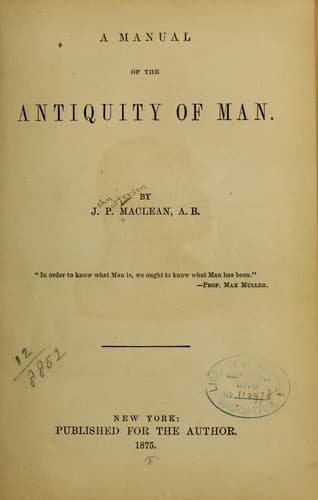
A Manual of the Antiquity of ManMacLean, J. P. (John Patterson)
History
A Manual of the Antiquity of Man
MacLean, J. P. (John Patterson)
Human beings -- Origin
In 1840, Rev. J. MacEnery, of Devonshire, England, found in a cave,
called Kent's Hole, human bones and flint knives among the remains of
the mammoth, cave-bear, hyena, and two-horned rhinoceros, all from under
a crust of stalagmite. Mr. MacEnery began the explorations of this cave
as early as 1825. He did not publish his notes on his discoveries but
they remained in manuscript until 1859, when they were obtained by Mr.
Vivian.
Mr. Godwin-Austen, in his communication to the Geological Society in the
year 1840, states, in his description of Kent's Hole, he found works of
art in all parts of the cave.
The fossil Man of Denise was discovered by a peasant, in an old volcanic
tuff, near the town of Le Puy-en-Velay, Central France, an account of
which was first published by Dr. Aymard, in 1844. Able naturalists, who
have examined these bones, especially those familiar with the volcanic
regions of Central France, declared that they believed them to have
been enveloped by natural causes in the tufaceous matrix in which they
are now seen.
In the years 1845-1850, Casiano de Prado made discoveries on the banks
of the Manzanares, near Madrid. They consisted of portions of the
skeletons of the rhinoceros, and a nearly perfect skeleton of an
elephant in the diluvial sand. Lying beneath this ossiferous sand, were
several flint axes of human workmanship.
[Illustration: FIG. 1. SIR CHARLES LYELL.]
Near the town of Aurignac, France, a workman named Bonnemaison, in the
year 1852, accidently discovered a cave containing the remains of
seventeen human skeletons. These bones were taken by Dr. Amiel, the
mayor of Aurignac, who was ignorant of their value, and consigned to the
parish cemetery. The spot of their re-inhumation has been forgotten, and
this treasure is now lost to science. In 1860, the cave was explored by
Edward Lartet. After a long and patient examination, he came to the
conclusion that the cave was a human burial place, cotemporary with the
mammoth and other great animals of the quaternary epoch.
It was at the meeting of the British Association, in 1855, that Sir
Charles Lyell declared his belief in the great antiquity of the human
race. He had before opposed the idea, but was convinced of the truth by
personal examination of human bones and flint hatchets, from the
quarries of St. Acheul. He became enthusiastic in his investigations,
and, in order to present the discussion clearly to the scientific
public, he published his "Geological Evidences of the Antiquity of Man,"
in 1863. In the last edition of his "Principles of Geology," he bestows
considerable space to the discussion of the subject. He was closely
followed, in the same view, by other eminent geologists.
Public-domain text, read in full here on John Shaqi.
Reviews
Reviews
No reviews yet
Be the first to share your thoughts on this work.
Join the Discussion
Join the discussion
Sign in to leave a comment or review.
Sign InorCreate an account