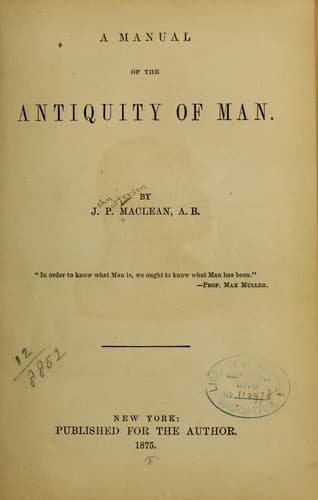
A Manual of the Antiquity of ManMacLean, J. P. (John Patterson)
History
A Manual of the Antiquity of Man
MacLean, J. P. (John Patterson)
Human beings -- Origin
The flint implements from Hoxne were found under three different layers
or beds. The first, vegetable, a foot and a half in depth. The second
was clay, seven and a half feet thick. The third, a bed of sand, with
shells one foot in thickness. The fourth layer, containing the
implements was a bed of gravel two feet in depth. The number of these
flints was so great that they were carried out by the baskets-full, and
thrown into the ruts of the adjoining road. On account of the great
number, this spot might have been the place where they were
manufactured. Their date is not coeval with the bowlder clay, but
undoubtedly belong, to the last of this epoch.
The human bones found in the loess of the Rhine, near Colmar, were two
fossilized fragments of the skull. They were found in undisturbed soil
along with the fossil bones of the extinct species of mammoth, horse,
gigantic deer, aurochs, and other mammalia. The fragment of the skull
"showed a depressed forehead, strongly projecting superciliary arches,
and a type, on the whole, approaching the so-called _dolichocephalic_,
or long-headed form."[22] These remains date so near the end of the
glacial as to almost enter the inter-glacial.
CHAPTER III.
GLACIAL EPOCH--CONTINUED.
_Belgian Caverns._--The relics discovered by Dr. Schmerling, in the
caves of Belgium, must be referred to the time of the retreat of the
glaciers. The glaciers were still in existence, but their receding had
freed immense tracts of land, and the space they now covered was small
in proportion to their former extent. Whether it be considered or not,
that vegetation greatly nourished and the great wild beasts were rapidly
increasing, one thing must be noticed, and that is, floods must have
succeeded or followed closely upon the retreat of the ice. Many remains,
referred to the glacial epoch, may in reality, have occupied the time of
the floods occurring just previous to the commencement of the
inter-glacial.
The Belgian Caverns, near Liége, either belong exactly to the ice, or
else to a period not far removed. Lyell considers the older monuments of
the palæolithic period to be the rude implements found in ancient river
gravel and in the mud and stalagmite caves.[23] Caves of this
description are those reported on by Dr. Schmerling.
Public-domain text, read in full here on John Shaqi.
Reviews
Reviews
No reviews yet
Be the first to share your thoughts on this work.
Join the Discussion
Join the discussion
Sign in to leave a comment or review.
Sign InorCreate an account