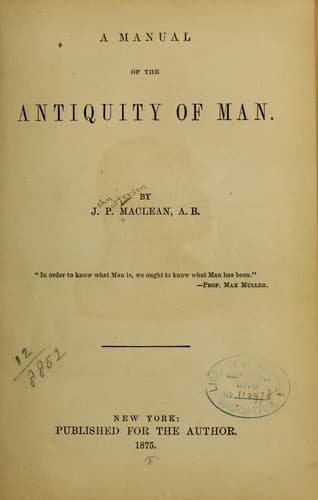
A Manual of the Antiquity of ManMacLean, J. P. (John Patterson)
History
A Manual of the Antiquity of Man
MacLean, J. P. (John Patterson)
Human beings -- Origin
The mode of life, together with the trials of his strength, developed
his muscular system. His muscles became large and tough, and his bones
thick and heavy. The earliest type of man is generally supposed to be
_dolichocephalic_, or long-headed. The walls of the skull were thick,
and the crown low. He was of ordinary stature, but built for action, and
of great power. His make-up was the result of his surroundings.
His advancement was very slow. Throughout the entire length of the
miocene and pliocene epochs it is not traceable. There was no revolution
in his mind; one step in advance would have been a mighty leap. Nor
could it be expected that there should be rapid progress. The mind was
brutal; and all the instincts sensual. But there was pending a mighty
change. The tropical climate should change into a winter of snow and
ice. Man should feel it, and be benefited by the new danger. His
sluggish mind should be quickened, and the inventive genius should be
called into action. The sun no longer could give its heat. The forests
grew cold, the chilling winds swept over the plains, and the retreat in
the cave was damp and forbidding. The wild beasts were either dying of
cold, or else becoming clothed with thick, long hair, and retreating
before the accumulating snow. Man earnestly looked about him. He
suffered greatly, and his numbers grew less. Fire had been produced.
How, no one can tell; possibly by accident. He now became more careful
of the fire, and with brand in hand he went from place to place kindling
the fires at the various resting-places. Nor was this sufficient. His
ingenuity was taxed to its greatest extent. Colder and colder grew the
winds. The snow, coming in great flakes, was soon consolidated, and
became as ice. The body could not be kept warm. Clothing must be had,
and this must be furnished by the wild beasts. Their hides must assist
in protecting the life of man. The stiffened, frozen animals would not
alone furnish sufficient covering. Knives must be invented. From the
flint rude knives were fashioned, by means of which the skins were
removed and transferred to the bodies of men. But the long winter
continuing, the lives of the living animals must be forfeited, both for
the flesh and and the skins. Rude, almost shapeless arrow-heads were
produced. Wood must be had with which to warm and cook, and rude rafts
formed, by means of which the swelling rivers might be crossed. Then
those stone hatchets of the Somme were shaped, and answered the purpose.
Public-domain text, read in full here on John Shaqi.
Reviews
Reviews
No reviews yet
Be the first to share your thoughts on this work.
Join the Discussion
Join the discussion
Sign in to leave a comment or review.
Sign InorCreate an account