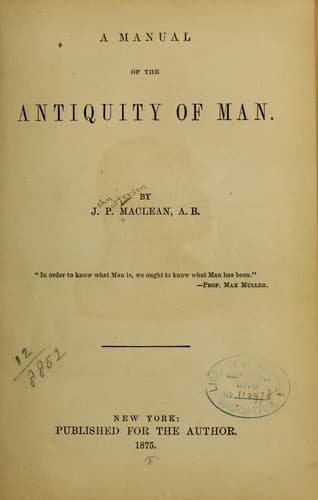
A Manual of the Antiquity of ManMacLean, J. P. (John Patterson)
History
A Manual of the Antiquity of Man
MacLean, J. P. (John Patterson)
Human beings -- Origin
On the right is shown the megatherium. This animal belonged to the
sloth tribe, and was a native of South America. It exceeded in
size the largest rhinocerous, and the length of its skeleton
sometimes attained eighteen feet. In front, near the centre, is
the glyptodon another South American animal of the armadillo
tribe. The length of its shell, along the curve, was five feet,
and the total length of the animal, nine feet. Just back of the
glypodon, and holding on to a tree, is the mylodon, belonging to
both North and South America, one species of which was much larger
than the western buffalo. On the left, and in the rear, is the
mastodon, the remains of which are found in both North and South
America, though of different species. While this scene does not
represent the animals with which we are dealing, yet the general
features give an idea of those with which we are interested.]
[Illustration: FIG. 12. SECTION OF THE SEPULCHRAL GROTTO, IN THE HILL
OF FAJOLES, AURIGNAC.
_a._ Vault in which the seventeen human skeletons were found.
_b._ Layer of made ground, two feet thick, inside the grotto in
which a few human bones, with entire bones of extinct and
living species of animals, and many works of art, were
imbedded.
_c._ Layers of ashes and charcoal eight inches thick, containing
broken, burned, and gnawed bones of extinct and living
mammalia, also hearth-stones and works of art; no human
bones.
_d._ Deposit with similar contents; also a few scattered cinders.
_e._ Talus of rubbish washed down from the hill above.
_f_, _g._ Slab of rock which closed the vault.
_i_, _f._ Rabbit-burrow.
_h_, _k._ Original terrace.
_N._ Nummulitic limestone.]
In the cavern of Maccagnone, in Sicily, there were found ashes and rude
flint implements in a breccia containing the bones of the elephant (_E.
antiquus_), hyena, a large bear, lion, (probably _F. spelæa_), and large
numbers of bones belonging to the hippopotamus. The concrete of ashes
had once filled the cavern, and a large piece of bone breccia was still
cemented to the roof.
The vast number of hippopotamuses implies that the physical condition of
the country was different from what it is at present. The bone breccia
cemented to the roof, and coated with stalagmite, testifies that the
cave, at some time since the formation of the breccia, has been washed
out. The exact time of the formation of this breccia cannot be given,
but, in all probability, not long after the extinction of the cave-bear,
if not before.
Public-domain text, read in full here on John Shaqi.
Reviews
Reviews
No reviews yet
Be the first to share your thoughts on this work.
Join the Discussion
Join the discussion
Sign in to leave a comment or review.
Sign InorCreate an account