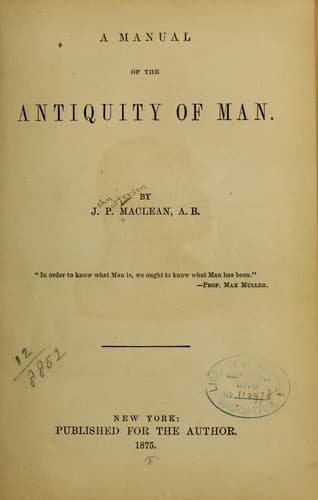
A Manual of the Antiquity of ManMacLean, J. P. (John Patterson)
History
A Manual of the Antiquity of Man
MacLean, J. P. (John Patterson)
Human beings -- Origin
Controversy--Perversion of meaning--Men of science branded--
Design of the chapter--Creation--"Bara"--Day--Man's
appearance--Two accounts--Case of Cain--Sons of God--Remarks
of Dr. Livingstone--Doctrine of unity of the race--
Chronology--The Deluge--Septuagint--Monarchies--The
Dispersion--Opinion of Dr. Hedge--No supernatural aid in the
formation of Language--What God may do does not imply what
he has done--Dean Stanley on the Biblical account of Creation. 143
A MANUAL OF THE ANTIQUITY OF MAN.
CHAPTER I.
INTRODUCTION.
No subject, of late years, has so much engrossed the attention of
geologists as the antiquity of the human race. The interest was greatly
increased by the publication of Sir Charles Lyell's "Antiquity of Man."
This work called the attention of the public to the subject, and so
great became the interest that many volumes and memoirs have been added
to the list, discussing the question in various ways, and, for the most
part, in such a manner as to add fresh interest and throw more light on
the subject. The scientific men were slow to take advantage of the
discoveries continually being made of the bones and works of man found
in caves and associated with the remains' of extinct animals. It is
probable, even at this late day, there would not have been so much
discussion of this subject had not Sir Charles Lyell lent the weight of
his great name to it. Educated men, everywhere, began to doubt the
correctness of Archbishop Usher's chronology, and so complete has been
the revolution of opinion that it is almost impossible to find an
intelligent man who would limit the period of man's existence to 6,000
years.
To Aimé Boué, a French geologist, must be attributed the honor of having
been the first to proclaim the high antiquity of the human race; to Dr.
Schmerling, the learned Belgian osteologist, on account of his
laborious investigations, untiring zeal, and great work on the subject,
the merited title of being the founder of the new science; to M. Boucher
de Perthes, its great apostle; while to Sir Charles Lyell and Sir John
Lubbock must be ascribed the honor of having made the new theory
popular.
The new science soon became permanently established, and the geologists
at once set about classifying the facts before them, in order to assign
to them their respective places in the geological epochs. All are agreed
in respect to the chronological orders, but all have not used the same
nomenclature, in consequence of which more or less confusion has been
the result. Sir J. Lubbock has divided pre-historic archæology into four
great epochs, as follows:
"I. That of the Drift; when man shared the possession of Europe with the
mammoth, the cave-bear, the woolly-haired rhinoceros, and other extinct
animals. This we may call the 'Palæolithic' period.
Public-domain text, read in full here on John Shaqi.
Reviews
Reviews
No reviews yet
Be the first to share your thoughts on this work.
Join the Discussion
Join the discussion
Sign in to leave a comment or review.
Sign InorCreate an account