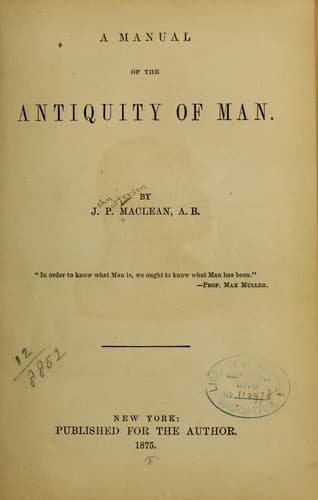
A Manual of the Antiquity of ManMacLean, J. P. (John Patterson)
History
A Manual of the Antiquity of Man
MacLean, J. P. (John Patterson)
Human beings -- Origin
The recent explorations made by Mariette among the archives of Egypt
have confirmed the testimony of Manetho. The names of the kings, their
order of succession, and the length of their reigns correspond with
Manetho's table. These discoveries not only testify to the great
antiquity of the empire, but also throw light on the nation, its
manners, and customs. There were found stools, cane-bottomed chairs,
work-boxes, nets, knives, needles, toilet ornaments, earthenware, seeds,
eggs, bread, straw baskets, a child's plaything, paint boxes, with
colors and brushes, etc., from three thousand to six thousand years old.
There were also found the jewels of Queen Aah-hotep, who lived 1700 B.
C., consisting of exquisite chains, diadems, ear-rings, and bracelets,
which no modern queen would hesitate to wear.
These statements are still further confirmed by the testimony of
geology. In the year 1850 borings were commenced in the mud deposit of
the Nile. The most important results were obtained from an excavation
and boring made near the base of the pedestal of the statue of Rameses
at Memphis, the middle of whose reign, according to Lepsius, was 1361 B.
C. Assuming with Mr. Horner that the lower part of the platform or
foundation was fourteen and three-fourths inches below the surface of
the ground, or alluvial flat, at the time it was laid, there had been
formed between that period and the year A. D. 1850, or during the space
of three thousand two hundred and eleven years, a deposit of nine feet
four inches round the pedestal, which gives a mean increase of three and
one-half inches in a hundred years. It was further ascertained, by
sinking a shaft near the pedestal, and by boring in the same place, that
below the level of the old plain the thickness of old Nile mud resting
on desert sand amounted to thirty-two feet; and it was therefore
inferred by Mr. Horner that the lowest layer (in which a fragment of
burned brick was found) was more than thirteen thousand years old, or
was deposited thirteen thousand four hundred and ninety-six years before
the year 1850."[96] Other excavations were made on a large scale. In the
first sixteen or twenty-four feet there were dug up jars, vases, pots, a
small human figure in burnt clay, a copper knife, and other articles
entire. When the water soaking through from the Nile hindered the
progress of the workmen, boring was resorted to, and almost everywhere,
and from all depths, even where they sank sixty feet below the surface,
pieces of burned brick and pottery were extracted.[97]
Public-domain text, read in full here on John Shaqi.
Reviews
Reviews
No reviews yet
Be the first to share your thoughts on this work.
Elsewhere in the archive
Join the Discussion
Join the discussion
Sign in to leave a comment or review.
Sign InorCreate an account