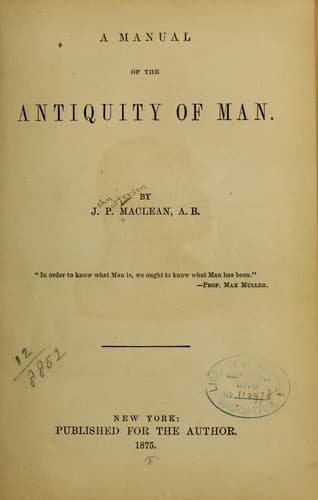
A Manual of the Antiquity of ManMacLean, J. P. (John Patterson)
History
A Manual of the Antiquity of Man
MacLean, J. P. (John Patterson)
Human beings -- Origin
_Troy._--Troy, made immortal by the poem of Homer, has recently been
uncovered to the eye of man, and fresh lustre has been thrown over the
ancient bard. The descriptions of Troy given by Homer, thought to have
been a mere work of imagination, are now shown to be accurate, and also
that he must have been there. For the re-discovery and unearthing of
Troy the world is indebted to Dr. Schlieman. Four buried cities
superimposed one above the other were discovered. The third city, below
the surface, is ancient Troy. The house of Priam, the Scæan gate, the
massive walls and pavements, still remained. In the house of Priam Dr.
Schlieman found a great mass of human bones, among them two entire
skeletons wearing copper helmets, a silver vase, two diadems of golden
scales, a golden coronet, fifty-six golden ear-rings, eight thousand
seven hundred and fifty gold rings, buttons, etc. Immediately beside the
house of Priam, closely packed in a quadrangular space, surrounded with
ashes, and near by a copper key, were a large oval shield of copper, a
copper pot, a copper tray, a golden flagon, weighing nearly a pound,
several silver vases, a silver bowl, fourteen copper lance-heads,
fourteen copper battle-axes, two large two-edged daggers, a part of a
sword, and some smaller articles. The value, by weight alone, of all the
gold and silver found in or near the house of Priam, has been estimated
at twenty thousand dollars. During the excavations, over one hundred
thousand articles were found. Every mark showed that Troy had been
suddenly destroyed. Conflagration, ruin, the implements and the effects
of war were visible. Even the brave warriors who fell while defending
the palace of their king have not yet wholly crumbled into dust.
The four cities may be thus summed up: The topmost stratum is six and
one-half feet in depth and covers the Grecian settlement which was
established about the year 700 B. C. Beneath the Greek masonry are found
the walls of another city, built of earth and small stones, but the
abundance of wood-ashes shows that the city--or the successive
cities--was chiefly built of wood.
The ruins of Troy, next in succession, are from twenty-three and
one-half to thirty-three and one-half feet from the surface, and form a
stratum averaging ten feet in thickness. Troy is supposed to have been
founded about 1400 B. C., and its fall and destruction by fire to have
occurred about 1100 B. C.
Public-domain text, read in full here on John Shaqi.
Reviews
Reviews
No reviews yet
Be the first to share your thoughts on this work.
Elsewhere in the archive
Join the Discussion
Join the discussion
Sign in to leave a comment or review.
Sign InorCreate an account