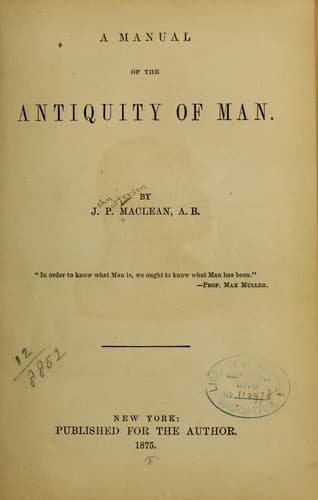
A Manual of the Antiquity of ManMacLean, J. P. (John Patterson)
History
A Manual of the Antiquity of Man
MacLean, J. P. (John Patterson)
Human beings -- Origin
Investigations which have been made among the ruined cities of Chaldea
have given great weight to the authority of Berosus, and are tending to
the confirmation of his history. In Susiana there was found a Cushite
inscription, mentioned by Rawlinson, in which there is a date that goes
back nearly to the year 3200 B. C. The testimony of the records
disentombed from the ruins, as well as Berosus, contradicts the
prevalent hypothesis that the Magian or Aryan race occupied the country
before the Cushites. These ruins also "confirm Berosus by showing that
Chaldea was a cultivated and flourishing nation, governed by kings, long
previous to the time when the city known to us as Babylon rose to
eminence and became the seat of empire. During that long time there were
several great political epochs in the history of the country,
representing important dynastic changes, and several transfers of the
seat of government from one city to another. Such epochs in Chaldean
history are indicated by the list of Berosus."[99]
By this people, the science of astronomy was well understood.
"Callisthenes, who accompanied Alexander to Babylon, sent to Aristotle
from that capital a series of astronomical observations which he had
found preserved there, extending back to a period of one thousand nine
hundred and three years from Alexander's conquest of the city.... These
observations were recorded in tablets of baked clay.... They must have
extended, according to Simplicius, as far back as 2234 B. C., and would
seem to have been commenced and carried on for many centuries by the
primitive Chaldean people." A lens of considerable power, used for
either magnifying or condensing the rays of the sun, was found at
Babylon, in a chamber of the ruin called Nimroud.[100]
_China._--Litse, an eminent Chinese historian, relates that there were
long periods of time when the Chinese kingdom flourished, the chronology
of which is not preserved, although there is recorded some knowledge of
the rulers. One of these rulers promoted the study of astronomy. Next
come the historical epochs. During the first, astronomy, religion, and
the art of writing were cultivated. This was a great epoch, and ruled by
fifteen successive kings. In the second epoch, agriculture and medical
science were promoted. In the third, the magnetic needle was discovered,
the written characters improved, civilized life advanced, and a great
revolt suppressed. In the fourth and fifth epochs, the descendants of
the previous ruler reigned. Next came the period of Yao and Shin. After
this the period of the "Imperial Dynasties," which began with the
Emperor Yu, who lived two thousand two hundred years B. C. The
historical work of Sse-ma-thi-an narrates events chronologically from
the year 2637 B. C. to 122 B. C.[101]
Public-domain text, read in full here on John Shaqi.
Reviews
Reviews
No reviews yet
Be the first to share your thoughts on this work.
Elsewhere in the archive
Join the Discussion
Join the discussion
Sign in to leave a comment or review.
Sign InorCreate an account