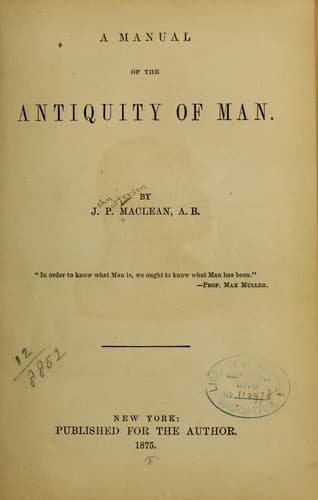
A Manual of the Antiquity of ManMacLean, J. P. (John Patterson)
History
A Manual of the Antiquity of Man
MacLean, J. P. (John Patterson)
Human beings -- Origin
_Mexico._--It is known that books or manuscripts were abundant among
the ancient Mexicans. There were persons duly appointed to keep a
chronicle of the passing events. Las Casas, who saw the books, says they
gave the origin of the kingdom as well as the founders of the different
cities, and every different thing which transpired that was worthy of
note: such as the history of kings, their modes of election and
succession; their labors, actions, wars, memorable deeds, good or bad;
the heroes of other days, their triumphs and defeats. These chroniclers
calculated the days, months, and years. Nearly all these books were
destroyed at the instigation of the monks, and by the more ignorant and
fanatical Spanish priests. A vast collection of these old writings were
burned in one conflagration by order of Bishop Zumarraga. A few of the
works, however, escaped, but none of the great books of annals described
by Las Casas.[102] Thus Mexico must be left to the archæologist
unassisted by written history.
CHAPTER XVI.
LANGUAGE.
The origin and growth of language evidently afford a great field for
study, in not only tracing the development of civilization, but also in
confirming the testimony of the ancients and the conclusions of the
geologists. If the unity of language could not be established, there
would still be left a field so great as would not lessen the interest or
the importance of the subject. But a new language cannot be formed. For
the sake of convenience the many varieties of language have been grouped
into three great divisions, _i. e._, the Aryan, the Semitic, and the
Turanian. "The English, together with all the Teutonic languages of the
Continent, Celtic, Slavonic, Greek, Latin with its modern offshoots,
such as French and Italian, Persian, and Sanskrit, are so many varieties
of one common type of speech: that Sanskrit, the ancient language of the
Veda, is no more distinct from the Greek of Homer, ... or from the
Anglo-Saxon of Alfred, than French is from Italian. All these languages
together form one family, one whole, in which every member shares
certain features in common with all the rest, and is at the same time
distinguished from the rest by certain features peculiarly its own. The
same applies to the Semitic family which comprises, as its most
important members, the Hebrew of the Old Testament, the Arabic of the
Koran, and the ancient languages on the monuments of Phoenicia and
Carthage, of Babylon and Assyria. These languages, again, form a compact
family, and differ entirely from the other family, which we called Aryan
or Indo-European. The third group of languages, for we can hardly call
it a family, comprises most of the remaining languages of Asia, and
counts among its principal members the Tungusic, Mongolic, Turkic,
Samoyedic, and Finnic, together with the languages of Siam, the Malay
Islands, Thibet, and Southern India. Lastly, the Chinese language stands
Public-domain text, read in full here on John Shaqi.
Reviews
Reviews
No reviews yet
Be the first to share your thoughts on this work.
Elsewhere in the archive
Join the Discussion
Join the discussion
Sign in to leave a comment or review.
Sign InorCreate an account