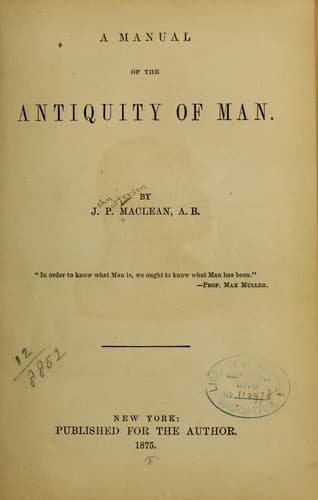
A Manual of the Antiquity of ManMacLean, J. P. (John Patterson)
History
A Manual of the Antiquity of Man
MacLean, J. P. (John Patterson)
Human beings -- Origin
The following answers may be given to these objections, or arguments: 1.
It is just as reasonable to suppose that man is affected, as well as the
animals, by climate, food, or peculiar condition. It is well known that
animals have undergone more or less change by their situation or
position. Elephants and rhinoceroses are almost hairless. As certain
extinct species, which formerly lived under an arctic climate, were
covered with hair or long wool, it would appear that the present species
of both genera had lost their hairy covering by exposure to heat. This
is confirmed by the fact that the elephants of the elevated and cool
districts of India are more hairy than those on the lowlands.[112] A
wonderful change is wrought by the influence of climate on turkeys. In
India "it is much degenerated in size, utterly incapable of rising on
the wing, of a black color, and with long pendulous appendages over the
beak, enormously developed." "In the English climate an individual Porto
Santo rabbit recovered the proper color of its fur in less than four
years."[113] Observers are convinced that a damp climate affects the
growth of the hair of cattle. The mountain-breeds always differ from the
lowland breeds; in a mountainous country the hind limbs would be
affected from exercising them more, which would also affect the pelvis,
and, then, from the law of homologous variation, the front limbs and
head would probably be affected.[114] One of the most marked
distinctions in the races of man is that the skull in some is elongated
or dolichocephalic, and in others rounded or brachycephalic. Mr. Darwin
has observed that a change takes place in the skulls of domestic
rabbits; they become elongated, while those of the wild rabbit are
rounded. He took two skulls of nearly equal breadth, the one from a wild
and the other from a large domestic rabbit, the former was only 3.15,
and the latter 4.3 inches in length. Welcker has observed "that short
men incline more to brachycephaly and tall men to dolichocephaly; and
tall men may be compared with the larger and longer-bodied rabbits, all
of which have elongated skulls."[115] The argument from language is of
great weight, especially in considering the differences in color.
Professor Max Müller has stated this clearly: "There was a time when the
ancestors of the Celts, the Germans, the Slavonians, the Greeks and
Italians, the Persians and Hindus, were living together beneath the same
roof." "The evidence of language is irrefragable, and it is the only
evidence worth listening to with regard to ante-historical periods. It
would have been next to impossible to discover any traces of
relationship between the swarthy natives of India and their conquerors,
whether Alexander or Clive, but for the testimony borne by
language."[116] When the great lapse of ages is taken into
consideration, since man originated, it will be seen that sufficient
time is given to produce the white, black, yellow, red, and brown
varieties of man.
Public-domain text, read in full here on John Shaqi.
Reviews
Reviews
No reviews yet
Be the first to share your thoughts on this work.
Elsewhere in the archive
Join the Discussion
Join the discussion
Sign in to leave a comment or review.
Sign InorCreate an account