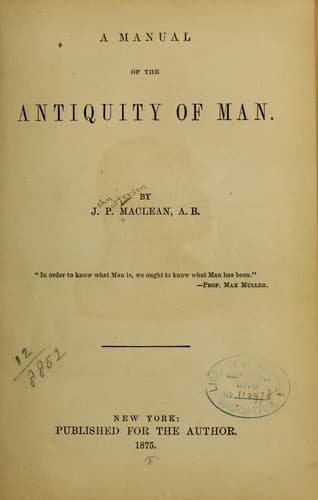
A Manual of the Antiquity of ManMacLean, J. P. (John Patterson)
History
A Manual of the Antiquity of Man
MacLean, J. P. (John Patterson)
Human beings -- Origin
There are from four thousand to six thousand living languages. The
number of unspoken languages is not known. Their growth has required
ages, and during their development many a parent stalk has ceased to
exist. The changes in a language are slowly produced. It requires
centuries to so far leave a language as to need an interpreter in order
to understand it. Some idea of this slow change may be gained by
comparing the writings in the English language of different periods. In
the year 1362 appeared a poem called "Piers Ploughman's Creed," which
begins as follows:
"In a summer season,
When soft was the sun,
I shoop me into shrowds[108]
As I a sheep[109] were;
In habit as an hermit
Unholy of werkes,
Went wide in this world
Wonders to hear;
Ac[110] on a May morwening
On Malvern hills
Me befel a ferly,[111]
Of fairy me thought." Etc.
Written language is more permanent than spoken, but the process of
either is necessarily slow. When it is remembered that a language has
been derived successively through numerous others, no special limit or
time can be given, although a very long period would be required. The
usually accepted chronology would not allow sufficient time for the
diversity in the Semitic family, to say nothing of the time required for
the development of the three general classes.
CHAPTER XVII.
UNITY OF THE HUMAN RACE.
The theory of the unity of the human race has caused a clash of opinions
among men of science. It has been the great battle field among
anthropologists, ethnologists, geologists, philologists, and
theologists. Men of acknowledged ability have been arrayed on either
side. Among the foremost in favor of a diversity of origin have been
Agassiz, Sir Roderick I. Murchison, Georges Pouchet, A. R. Wallace, and
Schleicher. But the weight of evidence and authority is most in favor of
the unity of the human race.
The advocates of the theory of the diversity of the origin of the human
race have advanced many objections against the unity, and produced
arguments in favor of their opinions. These may be summed up under five
heads. 1. The anatomical differences between the different races, and
especially those which distinguish the black and white. 2. The
separation of the races from each other for unknown ages by great
oceans, and by formidable and almost impassable continental barriers. 3.
The disparity in intelligence, and the grades in civilization. 4. A
medium type cannot exist by itself, except on the condition of being
supported by the two creating types. 5. When two types become united,
two phenomena may arise: _a_, Either one of them will absorb the other;
or _b_, They may subsist simultaneously in the midst of a greater or
less number of hybrids.
Public-domain text, read in full here on John Shaqi.
Reviews
Reviews
No reviews yet
Be the first to share your thoughts on this work.
Elsewhere in the archive
Join the Discussion
Join the discussion
Sign in to leave a comment or review.
Sign InorCreate an account