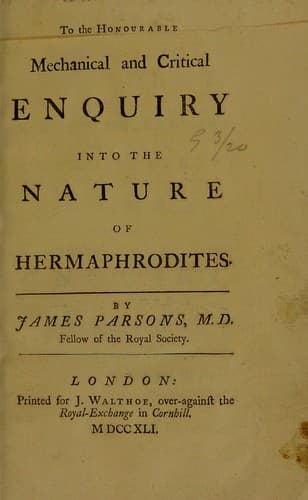
A mechanical and critical enquiry into the nature of hermaphroditesParsons, James
History
A mechanical and critical enquiry into the nature of hermaphrodites
Parsons, James
Intersexuality -- Early works to 1800
What has this Author described here, but a perfect Female? As to the
Nymphæ’s being entire, they are never known to be otherwise, except a
Dilaceration of them happens by some violence; the Carunculæ are indeed
liable upon slight Occasions to be broken, however in so young a Subject
it would be very strange to find them so, therefore there is nothing
extraordinary in this Part of his Description; but if he should mean by
the Word _entire_, that these two Parts were conjoin’d together, his
Notion of them seems somewhat imperfect, for the Nymphæ have their rise
at the Clitoris, and are lost on each Side before they reach the Orifice
of the Vagina; whereas the Carunculæ Myrtiformes are within the same, out
of any Manner of Communication with the former. The thin Membrane[32]
from the Perinæum that cover’d half the Orificium Vaginæ is not an
uncommon case; for in several this Skin runs over the whole Part, and
therefore this, no more than any Part of the above Description, is to
be counted proper to an Hermaphrodite. Again, there was no Appearance
of a Clitoris, and the Uterus and its Neck were exactly like those of a
Female. Though the Clitoris might have been then but small, yet that she
had it is most certain, for in some they grow surprisingly in a little
Time, and what our Author calls a Penis afterwards is nothing else; but
how he could find out that the Uterus and Cervix were like others is a
Riddle, since every Anatomist knows how remote these are from Sight in a
living Subject.
At last he says, ‘she pass’d for a Woman till the thirteenth Year,——when
kneading of Dough, all of a sudden, a Penis broke forth, four Inches long
in an Erection, situated as in a Man, with a Glans and Præputium fasten’d
to the Frænum, but the Glans being imperforated——deny’d egress to the
Semen, wherefore it made its way thro’ the Pudendum Muliebre, possibly in
a refluent Manner.’
Public-domain text, read in full here on John Shaqi.
Reviews
Reviews
No reviews yet
Be the first to share your thoughts on this work.
Join the Discussion
Join the discussion
Sign in to leave a comment or review.
Sign InorCreate an account