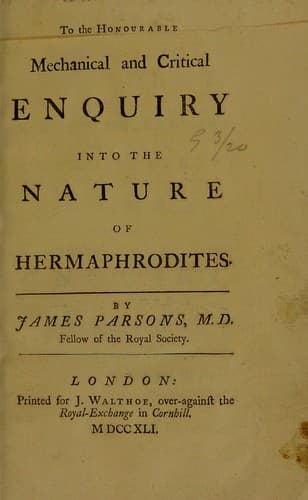
A mechanical and critical enquiry into the nature of hermaphrodites — John Shaqi
A mechanical and critical enquiry into the nature of hermaphroditesParsons, James
History
A mechanical and critical enquiry into the nature of hermaphrodites
Parsons, James
Intersexuality -- Early works to 1800
It is observable, that when Authors are fond of having their Readers
believe what they assert, they generally favour their own Opinions either
in Descriptions or Figures, so much as even to stretch from the Truth of
the Subject; which so far answers their Ends as to beget in some People,
indolently credulous, a Belief of what they see, and leads them into
an Error. This will appear, by the following Animadversions upon such
Authors as I thought would further answer our Intentions on the present
Occasion.
_Of MANARDUS._
It is not much to be wondered at, that the Name Hermaphrodite should be
so profusely made use of as it is among Men, when we find an Author of
no small esteem giving the same Name, in a general Way, to such as were
even troubled with several Kinds of Disorders in the Pudenda, besides a
supposed Existence of both Sexes in the same Person; for _Manardus_[78]
in a Letter to one _Michael Sactanna_, a Surgeon, sends him a List of
the Diseases incident to the exterior Parts of the Body, with a short
Definition of each, and speaking of such as he calls _utrique Sexui
communes_ has these Words[79]:
‘Hermaphrodites are so call’d by both _Greeks_ and _Latins_, of which
there are three Kinds in Men, one in Women. In Men the Similitude of the
Parts of Generation of a Woman is sometimes in the Scrotum; sometimes it
appears in the Perinæum; and sometimes Urine passes out by the Middle of
the Scrotum.
‘In Women, above the Pudenda, by the Pubis, the Form of the Parts of a
Man is prominent.’
It is very reasonable to imagine from this Passage, that the Author
cannot, by what he has here laid down, signify an hermaphrodital Nature
in a strict Sense, in any Person; because, according to our Definition
in the Beginning, there should be both Sexes amply subsisting in the
same Body, whereas here he says, in Men there are three Kinds of
them; in Women, one; and therefore if Men or Women, how can they be
Hermaphrodites? However, as to the first difference in Men, where
he says, ‘the Similitude of a Woman’s Parts is sometimes in the
Scrotum.’—The first Notion we can form of it is, that here is a Man
perfect in the Parts proper to him; besides which the Likeness of the
Parts of a Woman in the Scrotum. Now whenever any thing like a Fissure
appears in this Manner, I am inclined to believe it is the divided
Scrotum of certain Authors, which are no other than the _Labia Muliebria_
with the Clitoris over them, being equally protuberant to the lowermost
Part of the Orificium Vaginæ.
The Second is the perfect Man still supposed, and the Likeness of the
Pudenda Muliebria in the Perinæum. This amounts to the same thing as the
former, only the Thickness of the Labia reaches not down so far as the
Fissura Magna is continued; and therefore he supposes, that beneath the
said Protuberance, the rest of the Chink is the Perinæum[80].
Public-domain text, read in full here on John Shaqi.
Reviews
Reviews
No reviews yet
Be the first to share your thoughts on this work.
Join the Discussion
Join the discussion
Sign in to leave a comment or review.
Sign InorCreate an account