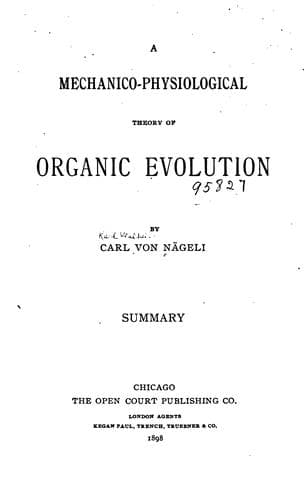
A Mechanico-Physiological Theory of Organic EvolutionNägeli, Carl
Science
A Mechanico-Physiological Theory of Organic Evolution
Nägeli, Carl
Evolution
The effective stimulus in a plasmic substance is dependent on its own
nature and the influence which it receives from without. Which group of
micellae in the idioplasm receives the stimulus depends on the
configuration, on the preceding stimuli and on the position in the
individual organism in which the idioplasm is found. The determinants
have arisen one after another during the whole period of evolution from
the primordial cell. The configuration of the idioplasm is a character
of phylogeny and the determinants in it have by nature the tendency to
develop in the order in which they were formed. Further, since the
ontogeny begins as a unicellular organism with the formation of a germ
cell, that determinant of the idioplasm comes first to development,
which has developed in the unicellular ancestor. Just so the succeeding
stages of ontogeny depend for the time being on the development of the
determinants having their origin in the corresponding stage of
phylogeny. Both causes acting together--the phylogenetic configuration
of the idioplasm and the successive morphological stages of development
of the individual conditioned on it--necessarily result in the ontogeny
being the repetition of the phylogeny.
If the whole remaining line of idioplasmic determinants in an ontogeny
has reached development, the development of the germ-forming
determinants finally follows as well from the configuration of the
idioplasm as from the nature of the organism. The individual is capable
of reproduction and the new ontogenies begin in the reproductive cells.
10. TRANSMISSION OF IDIOPLASMIC DETERMINANTS IN LOCAL VARIATION AND IN
FECUNDATION.
The automatic progressive or perfecting transformation of the idioplasm
is probably active in all stages of development, and proceeds regularly
in all parts of the organism, because the idioplasm preserves its
configuration at all times and places during the ontogeny. External
stimuli impign upon the organism usually at a definite point, but they
not only effect a local transformation of the idioplasm but also
reproduce themselves in a dynamic manner in the entire idioplasm, which
is in unbroken connection throughout the whole individual. The idioplasm
is thus changed everywhere in the same manner, so that the germ cells
that are given off at any point feel and inherit the effects of those
local stimuli.
In the formation of the germ cells in sexual reproduction, the
idioplasms of both parents must come into contact with each other,
whereupon there results either a material union and formation of a mixed
idioplasm or perhaps rather a dynamic action; and through these agencies
there is produced a remodeled form which is, however, exactly equivalent
to the combined idioplasms entering into it. Fertilization by diosmose
of the spermatic substance is impossible.[D]
Public-domain text, read in full here on John Shaqi.
Reviews
Reviews
No reviews yet
Be the first to share your thoughts on this work.
Join the Discussion
Join the discussion
Sign in to leave a comment or review.
Sign InorCreate an account