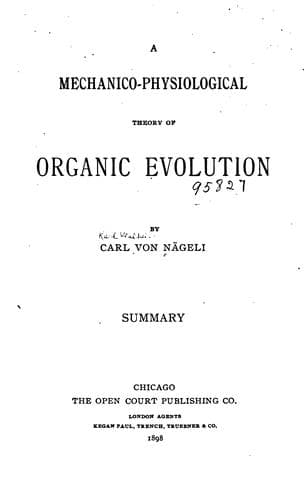
A Mechanico-Physiological Theory of Organic EvolutionNägeli, Carl
Science
A Mechanico-Physiological Theory of Organic Evolution
Nägeli, Carl
Evolution
[E] In order to explain adaptations Naegeli assumes that external
influences, if acting at the same point in a given manner for a
long time, may induce slight adaptive variations which are
perpetuated and increased. On the important subject of
adaptation in general Naegeli is almost diametrically opposed to
Darwin and Weismann. Naegeli assigns to the principle of utility
a very limited sphere; Weismann regards adaptation as
all-powerful. According to Naegeli, the organic world would have
become much what it is, if natural selection and adaptation had
performed no part in the operations of nature. He aptly says,
that natural selection prunes the phylogenetic tree, but does
not cause new branches to grow. He allows that the principle of
selection is well suited to explain the adaptation of organisms
to their environment and the suitableness and physiological
peculiarities of their structure, but he asserts that in the
definiteness of variation of plants and in their progressive
differentiation there is evidence of a higher and controlling
perfecting principle.--_Trans._
When the stress of environment exceeds the limits of idioplasmic
elasticity, its influence brings about permanent variations, which are
imperceptibly small, it is true, in the single individual, but which,
when the stimulus is active for a long period of time in the same
manner, increase to perceptible magnitude. These variations are
inheritable in the phylogenetic sense and contribute to the formation of
varieties and species; they always appear as the results of more or less
secondary reactions which make their appearance with stimuli exerted by
external causes.
External stimuli exerted on the organism are reproduced in the
idioplasm. Since the stimulus is discontinued with each change of the
ontogeny and only the idioplasm persists, permanent variations are
produced only in the idioplasm by those conditions that produce visible
transformations in the mature organism.
The phylogenetic action of external stimuli gives the definite character
of adaptation to the idioplasm as it becomes more complex from inner
causes and probably these external stimuli have the power to alter this
impress only as new idioplasm is automatically formed.
If an external cause acts continuously upon a phylogenetic line, the
corresponding variation of the idioplasm reaches, after a time, a
maximum, and thus comes to an end, either because the nature of the
substance permits no new rearrangement or because the stimulus is no
longer active. The cessation of the stimulus results from a micellar
rearrangement which indicates the character of the adaptation. If the
action of the stimulus lasts for only a short time, the incipient
rearrangement of the idioplasm stops, or proceeds independently on
account of the impulse received, and the determinant becomes capable of
development, even after the impulse has long ceased to act.
Public-domain text, read in full here on John Shaqi.
Reviews
Reviews
No reviews yet
Be the first to share your thoughts on this work.
Join the Discussion
Join the discussion
Sign in to leave a comment or review.
Sign InorCreate an account