A Mechanico-Physiological Theory of Organic Evolution — John Shaqi
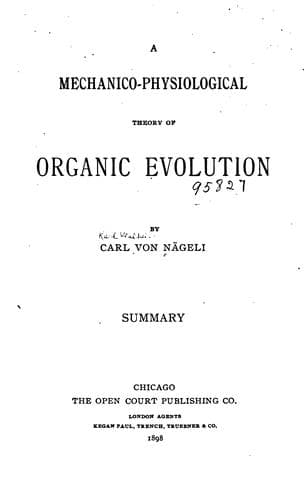
A Mechanico-Physiological Theory of Organic EvolutionNägeli, Carl
Science
A Mechanico-Physiological Theory of Organic Evolution
Nägeli, Carl
Evolution
_Races_ arise from gamogenic or pathological variations of the
idioplasm. In the former case they presuppose crossing between related
varieties or species, in the latter case an increased sensibility and
weakening of the idioplasm. Very often both causes co-operate, since
crossing follows more easily when the idioplasm is weakened by hurtful
influences and since the irritability and weakening of the idioplasm
increases if crossing has preceded. Race formation begins in single
individuals. Among several individuals it begins in various directions
because the causes are different and hence may display a great
multiformity. Races are distinguished by more or less abnormal
characteristics; they arise quickly--often in a single generation--and
present various degrees of stability. This stability is insured to some
extent only by the strictest in-and-in breeding. All races disappear
through crossing, likewise many races that have arisen from pathological
variations disappear even in sexual reproduction (in self-fecundation).
Races belong exclusively to cultivation, where they can develop and
exist protected from free intercrossing.
While varieties and races arise by progressional or stationary variation
of the idioplasm, _modifications_ are produced by such influences of
nutrition and climate as act only on the soma-plasm and the non-plasmic
substances, and hence do not give rise to inheritable characters in the
organism. Modifications persist only so long as their causes, and under
other environments immediately pass over into the modifications
corresponding to them. The transition is completed in the lowest plants
during a limited number of cell generations; in an individual of the
higher plants on the same stem during the growth of a single year. Each
variety and each race appears clothed in a definite modification, and
can change it within a range peculiar to itself.[A]
[G] The distinctions which Naegeli here erects are, of course,
purely arbitrary, and his definitions are suitable for use only
in his own thesis.--_Trans._
18. SOCIAL AND INDIVIDUAL ORIGIN OF SPECIES.
The species arises neither from the _nutrition variety_ nor from the
_race_; it is always a more advanced variety, and hence species
formation is identical with variety formation. Cause for variation and
consequently for variety formation is always shown, either when,
environment remaining the same, the automatic variation of the idioplasm
has advanced so far that the ontogeny is raised to a higher grade of
organization and division of labor, or when external stimuli act for a
sufficiently long time in a manner not in harmony with the previous
adaptation. Hence various varieties arise easily from a uniform kinship,
when these are thrown among unlike external influences by local
separation, because in the separated places on the one hand the
automatic evolution proceeds with unequal rapidity, and on the other
hand adaptation takes place unequally.
Public-domain text, read in full here on John Shaqi.
Reviews
Reviews
No reviews yet
Be the first to share your thoughts on this work.
Join the Discussion
Join the discussion
Sign in to leave a comment or review.
Sign InorCreate an account