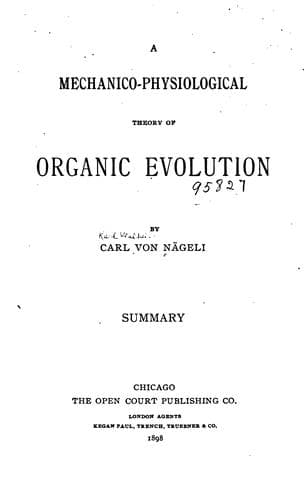
A Mechanico-Physiological Theory of Organic EvolutionNägeli, Carl
Science
A Mechanico-Physiological Theory of Organic Evolution
Nägeli, Carl
Evolution
Let us consider what non-sectarianism means. We cannot, for example,
isolate a single domain of science in a particular country and at a
particular time--say, mechanics in England in the eighteenth
century--and hope to make of it a thoroughly complete object of study.
In natural science, for example, we make conventional divisions simply
with the object of saving labor when dealing with the huge mass of
material that experience offers. But the narrowest specialist knows that
all workers in science, religion, and philosophy seek the Truth; and
that the Truth is bounded neither by space nor by time nor by man-made
divisions. A man may rightly conclude that he stands little chance of
finding out very much of the Truth, and so he may voluntarily limit his
view to a certain roughly defined domain of facts and thoughts, and
become, for example, what is called a "biologist," a "physicist," a
"higher critic," or, if he thinks that he may discover rather more of
the Truth, a "philosopher."
And let us carry a clear understanding of a lofty aim into religion as
well. It is our duty, as rational beings, to be non-sectarian. It is not
a merit to allow ignorance to blind us to the glimpses of Truth that we
sometimes get from prophets, poets, and priests of other religions and
other philosophies than our own. If we think that there is more truth or
sacredness in our own, let us use every means to make this sacredness or
this truth appear evident to others. But, in justice, let us also
fearlessly discuss other religions and philosophies, and discover their
greater merits, if any, as compared with our own. If, after careful
investigation, we arrive at the belief in the truth or falsehood of
anything in these religions or philosophies, let us state our grounds
for believing so in the fullest possible way. Only by so doing can we
fulfil the duties of being true to ourselves and helpful to others.
Sometimes the work of a critic is said to be "merely destructive." This
idea rests on a most harmful misunderstanding. Criticism consists not
only in the pointing out of error, but in the pointing out of truth as
well. Error is simply a psychological condition of blindness to the
truth; and the discovery of errors committed by other people or
ourselves is not--as many superficial people like to say--the pulling
down of a structure already raised, unless an error can be called a
structure which is built out of the fictions of our imagination which
have no objective existence. Criticism often enables us to discover more
of the Truth, and nobody can do more than _discover_ Truth: nobody
_creates_ Truth, any more than Columbus created America.
Nowadays all intelligent men and women agree that all knowledge must be
subjected to criticism, and the best men and women act on these beliefs.
The books and magazines published by the Open Court Company are intended
to help these men and women.
Public-domain text, read in full here on John Shaqi.
Reviews
Reviews
No reviews yet
Be the first to share your thoughts on this work.
Join the Discussion
Join the discussion
Sign in to leave a comment or review.
Sign InorCreate an account